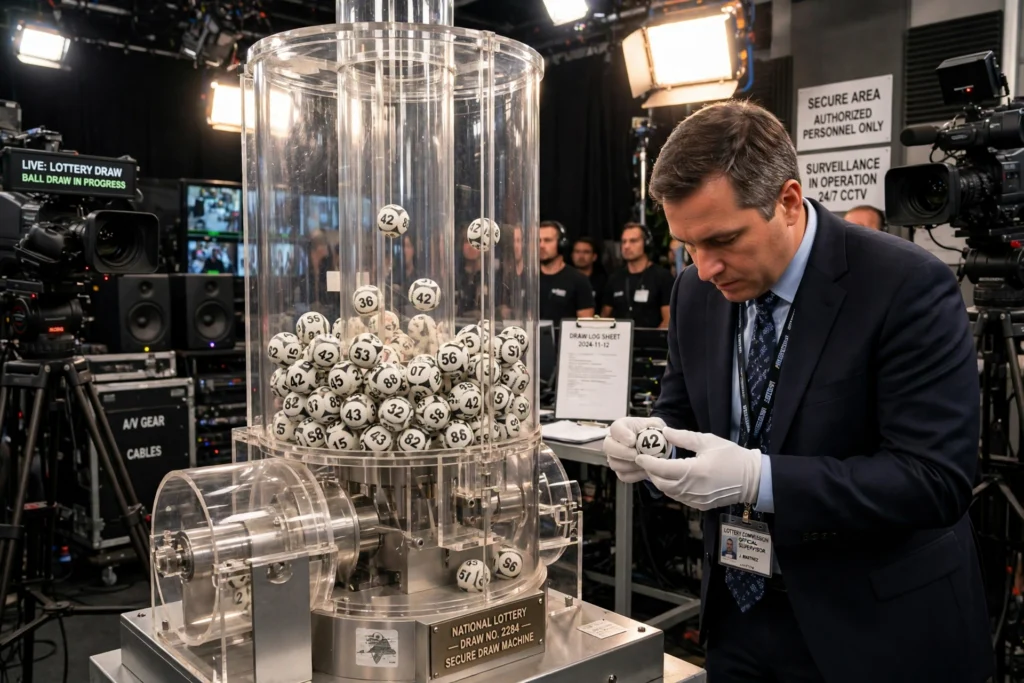
How lottery draws are audited is a question every player asks sooner or later: when billions of dollars are at stake, who makes sure the numbers are genuinely random? The short answer is that a lottery draw is one of the most watched and checked events in the world. Independent auditors — accountants who do not work for the lottery — are physically present at every major draw. The balls are weighed, the machines are tested, test draws are run, and every step is recorded on video and signed off in writing. This guide explains how lottery draws are audited from the vault to the final signature, using the published procedures of Powerball, Mega Millions and other national lotteries. You must be 18 or over to play the lottery in most countries — please play responsibly.
Table of Contents
- Why Lottery Draws Need Auditing
- Who the Auditors Are
- Before the Draw: Balls, Machines and Test Draws
- During the Draw: What the Auditor Watches
- After the Draw: Verification and Records
- How Electronic Draws and RNGs Are Audited
- How Lottery Draws Are Audited in Different Countries
- Watch: Behind the Scenes of a Powerball Draw
- Frequently Asked Questions
- Conclusion
Why Lottery Draws Need Auditing
A lottery only works if players trust the result. The moment people suspect a draw is fixed, ticket sales collapse — and so does the public funding the lottery provides. That is why lotteries do not audit themselves. Every major lottery builds its draw process around one principle: no single person should be able to influence the result, and every step should be witnessed and documented by someone independent. Auditing is not a single check at the end; it runs through the whole draw, from the moment the equipment leaves the vault to the moment the winning numbers are published. For a general overview of draw day, see our guide on how lottery draws are conducted and kept fair.
Who the Auditors Are
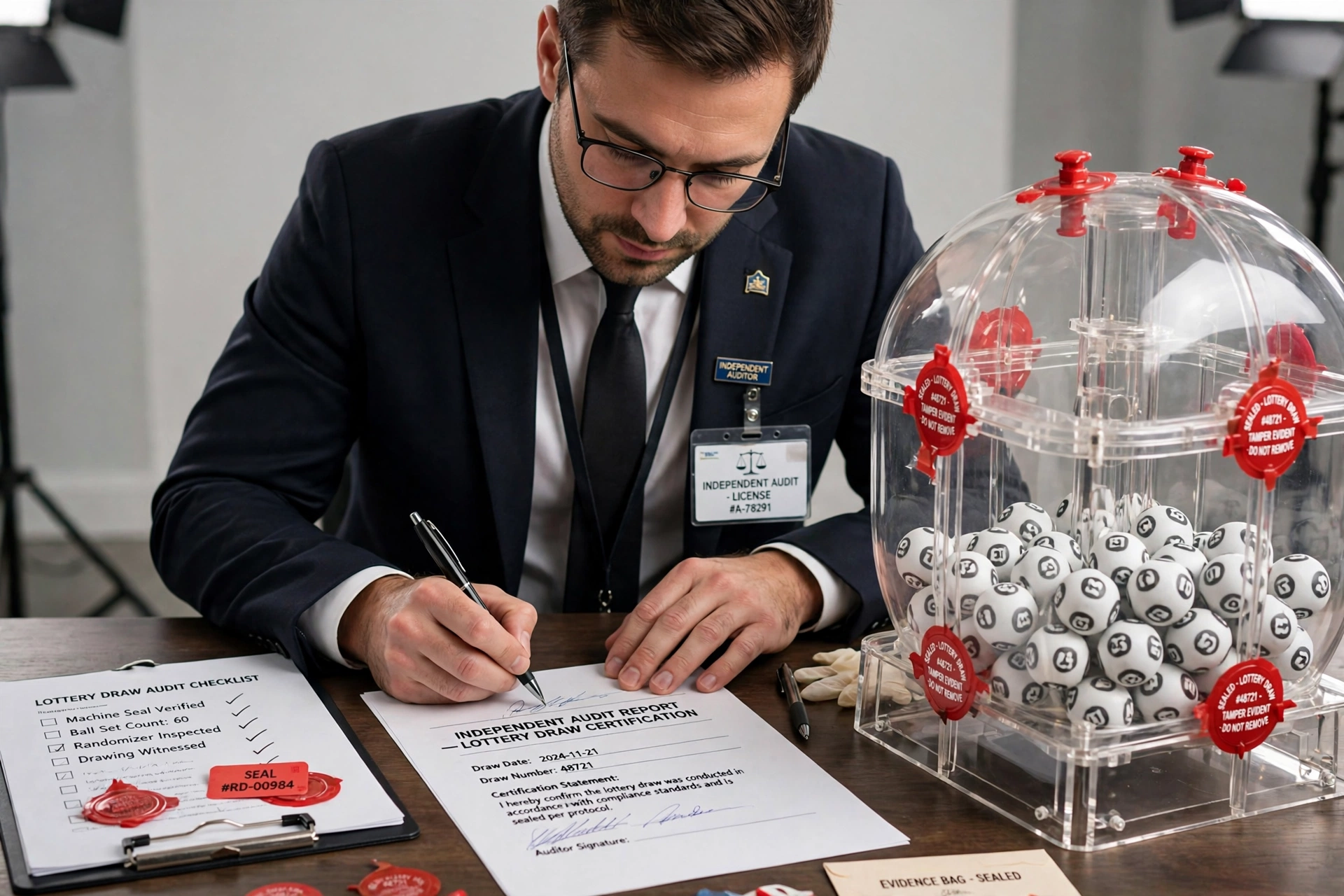
The people who audit lottery draws are independent accountants and auditors from outside firms — not lottery employees. In Florida, where Powerball drawings are held, the published draw rules require every drawing to be public and witnessed by an accountant employed by an independent certified public accounting firm, who must certify the integrity, security and fairness of each drawing. The same pattern holds elsewhere: Mega Millions draws are observed by an auditor from an independent accounting firm, and Canadian lotteries such as Loto-Québec have their draws supervised by an external audit firm (currently MNP). Without the independent auditor’s signature, a draw cannot be legally certified — the numbers are not official until the auditor signs.
Auditors do more than watch. They log the serial numbers of the ball sets, confirm ball weights on calibrated scales, check machine calibration records, and co-sign the official draw report alongside lottery staff. Specialist testing laboratories also play a role: firms such as Gaming Laboratories International (GLI) test and certify draw machines and random number generators against technical standards before they are ever used in a public draw, and re-test them regularly afterwards.
Before the Draw: Balls, Machines and Test Draws
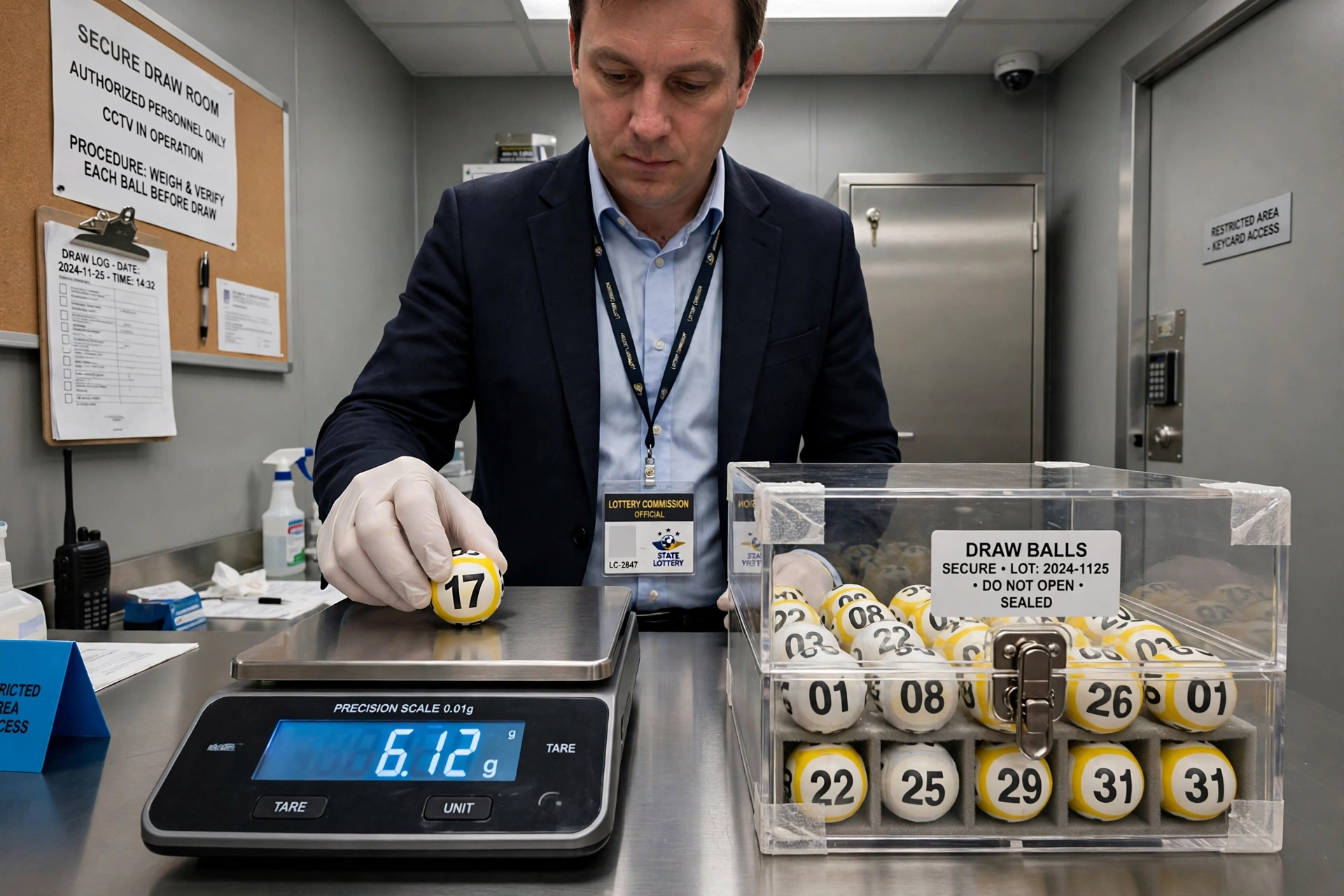
Most of the audit happens before a single ball is drawn. For a Mega Millions drawing, the routine takes about three hours for a draw that lasts under a minute. First, the draw officials and the auditor retrieve the equipment from a secure vault — in the case of Mega Millions, the balls are stored in suitcases inside a safe at the Georgia Lottery studio, and access requires more than one person. Then a machine and a ball set are chosen at random from the equipment available, so nobody can predict in advance which set will be used. Seven ball sets are randomly selected for each Mega Millions drawing, and the selection is verified by the auditor.
Next, the balls are checked. Each ball set is weighed on certified electronic scales to confirm that no ball has been altered — even a fingerprint’s weight can be detected by the sensitive scales used. Officials measure the balls and check them against the approved inventory. The machines are inspected before and after each drawing, and the auditor confirms that every ball in the set carries the same security code. Then come the test draws: the machines are run through several practice drawings to prove they are working properly, with the results recorded and discarded. In Virginia, officials arrive two hours before each draw to run through this checklist, including pre-test drawings and a rehearsal with the television crew. Only when the auditor is satisfied does the real draw begin.
During the Draw: What the Auditor Watches
During the draw itself, the auditor stands in the room and watches every ball. The draw is held in a restricted area under 24-hour video surveillance, and the whole event is recorded from multiple camera angles. The machines used by Powerball are gravity-pick machines — the Halogen II model from Smartplay International — in which spinning paddles tumble the balls and one ball at a time drops through an opening. Mega Millions uses air-mix machines, where jets of air keep the balls floating until a valve releases one. Either way, the auditor’s job is the same: confirm that the ball in the output slot matches the number shown on screen, watch for any mechanical anomaly, and stop the draw if anything looks wrong. The draw manager and the auditor both have the authority to halt proceedings immediately if a protocol is breached.
After the Draw: Verification and Records
When the last ball has dropped, the audit continues. The auditor checks the drawn numbers against the video recording, confirms the ball set is complete, and signs the official draw sheet. Used ball sets are sealed, and the seal is confirmed by the draw specialist and the auditor before the equipment goes back into the vault. The winning numbers are then published, and the recordings, draw sheets and calibration logs are archived — in many lotteries, these records are kept for years. If a dispute ever arises, the video and the signed paperwork are the evidence. This paper trail is also what protects winners: a verified, audited draw is very hard to challenge, and that is exactly the point.
How Electronic Draws and RNGs Are Audited
Not every lottery uses physical balls. Many daily games and second-chance drawings use a computerised random number generator (RNG), and these are audited differently — but no less strictly. An RNG used for a lottery draw is tested and certified by an independent laboratory recognised for its expertise, such as GLI, before it goes live. The software runs on air-gapped, tamper-evident computer systems, and auditors verify cryptographic hashes and digital signatures before each draw to confirm the software has not been changed. In electronic draws run by Loto-Québec, the external auditor runs its own independent system: wagers are confirmed between the lottery’s system and the auditor’s system before the draw is triggered, the draw is conducted, and the results are verified and confirmed by the auditor using its own system. Some lotteries, such as the Florida Lottery, now use automated trusted-draw systems for frequent games, where every result is mathematically verified by an independent audit system and cross-checked against the lottery’s own central system. For more on the machines themselves, see our guide to lottery draw machines: RNG vs ball draws.
How Lottery Draws Are Audited in Different Countries
The details vary, but the pattern is the same everywhere. In the United States, each state’s lottery follows published draw procedures, and multi-state games such as Powerball and Mega Millions add their own layer of independent observation. In the United Kingdom, National Lottery draws are monitored by an independent auditor who verifies that each draw follows procedure, and the Gambling Commission regulates the operator. In Canada, provincial lottery corporations submit to shared procedures under the Interprovincial Lottery Corporation for national games such as Lotto Max and Lotto 6/49, with external auditors present. And in every country, the same safeguards repeat: random equipment selection, weighed and sealed balls, test draws, an independent witness, video recording and a signed record. No system is perfect — history includes the rare case of an insider tampering with an RNG, which is precisely why modern procedures keep the auditor independent and the software sealed — but the layered audit is what makes a rigged draw extraordinarily difficult.
Watch: Behind the Scenes of a Powerball Draw
See the audit process for yourself in this official video from the Florida Lottery, filmed inside the Powerball draw studio in Tallahassee:
Frequently Asked Questions
Who audits lottery draws?
Independent accountants and auditors from outside firms audit lottery draws. They do not work for the lottery. In Florida, the rules require an accountant from an independent certified public accounting firm to witness and certify every drawing.
Are lottery balls weighed before a draw?
Yes. Before each draw, officials weigh every ball on certified electronic scales to confirm that no ball has been altered or tampered with, and the independent auditor observes and signs off on the checks.
How long does a lottery draw audit take?
For a Mega Millions drawing, the pre-draw routine takes about three hours — weighing balls, selecting equipment at random, running test draws and rehearsing — for a draw that lasts under a minute.
Are electronic lottery draws audited too?
Yes. Random number generators are tested and certified by independent laboratories such as GLI, and in electronic draws the external auditor verifies the results using its own independent system before the numbers are published.
Can a lottery draw be rigged?
Modern draws are protected by many layers: random equipment selection, weighed and sealed balls, test draws, an independent auditor in the room, 24-hour video surveillance and signed records. Rigging a draw would require defeating all of these at once, which is why it is considered extraordinarily difficult — and why lotteries publish their procedures.
What happens if something goes wrong during a draw?
The draw manager and the independent auditor can halt the draw immediately if equipment fails or a procedure is breached. The draw is then re-run under the same audited conditions, and the incident is documented.
Conclusion
How lottery draws are audited comes down to one idea: trust, but verify — with someone independent doing the verifying. Weighed and sealed ball sets, randomly selected machines, test draws, an independent accountant in the room, video from every angle and a signed record together make the modern lottery draw one of the most transparent public events there is. The system is not there to convince you that winning is likely — the odds are exactly what the maths says they are. It is there to guarantee that every ticket has the same fair chance. And if anyone ever contacts you claiming you have won a prize you never entered, read our guide to lottery scams and fake win notifications before you reply. The lottery is entertainment for adults: you must be 18 or over to play, so please play responsibly and only spend what you can afford to lose.
Related guides: How Lottery Draws Are Conducted and Kept Fair · Lottery Draw Machines: RNG vs Ball Draws · Lottery Scams: Fake Win Notifications
Sources: Powerball (official) · Gaming Laboratories International (GLI) · UK Gambling Commission