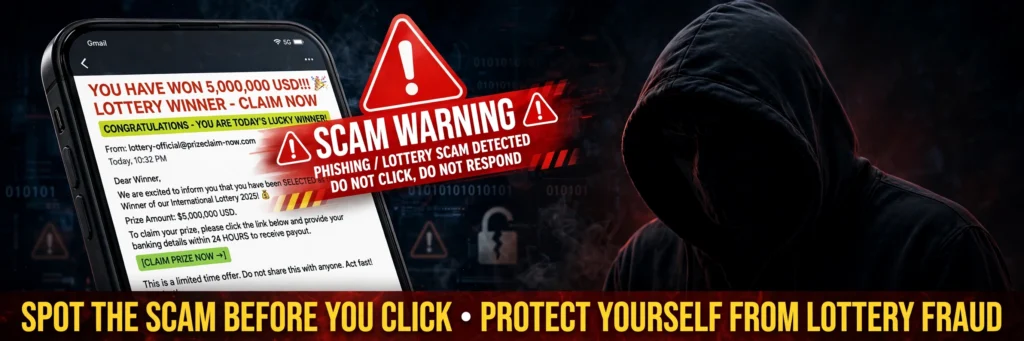
Lottery Scams to Avoid: How to Spot Fake Prize Notifications
“You’ve won the lottery!” It is one of the most exciting sentences in the English language — and one of the most dangerous when it arrives unexpectedly. Lottery scams are among the most common frauds in the world, targeting millions of people every year through emails, phone calls, text messages, and social media. The good news: every lottery scam follows predictable patterns, and once you know them, they are easy to spot. This guide walks through the lottery scams to avoid so you can recognize fake prize notifications before they cost you money.
Table of Contents
The Golden Rule
You cannot win a lottery you never entered. If you did not buy a ticket or enter a draw, any message saying you won is a scam — no exceptions. Keep this single rule in mind and you will be immune to the vast majority of lottery fraud.
The second rule is just as important: a legitimate lottery will never ask you to pay money to receive a prize. No “processing fees,” no “taxes upfront,” no “insurance,” no “courier charges.” Real winnings are paid to you; you never pay to unlock them.
7 Common Lottery Scams to Avoid
1. The Advance-Fee Prize Claim
The classic. You receive an official-looking notification that you have won a large prize, but before it can be released you must pay a fee — for taxes, legal costs, insurance, or bank transfer charges. Once you pay, the scammers either disappear or invent new fees. The prize never existed.
How to avoid it: Never send money to claim a prize. Ever.
2. Fake Winner Emails and Letters
These arrive dressed up with logos, batch numbers, claim codes, reference numbers, signatures, and formal legal language. Some even include fake certificates. They are designed to look exactly like correspondence from a real lottery organization.
How to avoid it: Do not reply, and do not click any links. If you want to verify, open your browser and type the lottery’s official website address yourself — never use links or phone numbers from the suspicious message.
3. Phone Call Scams
A caller claims to represent a lottery or prize commission and tells you that you have won. They create urgency, keep you on the phone, discourage you from talking to family or bank staff, and demand immediate payment — often via wire transfer, gift cards, or cryptocurrency. Some even follow up pretending to be law enforcement offering to “recover” your money for another fee.
How to avoid it: Hang up. Legitimate lotteries will always let you call them back later through their official published number.
4. SMS, Text, and WhatsApp Messages
Short messages claim you have been “selected” as a winner and ask you to click a link or message a “claims agent.” The link leads to a phishing site designed to steal your login credentials, banking details, or personal information.
How to avoid it: Do not click. Do not reply. Report spam texts to your carrier (in the UK, forward them to 7726; in the US, report to the FTC).
5. Fake Lottery Websites
Scammers build convincing copies of real lottery websites — same branding, same layout — and use them to harvest login details, card numbers, and identity documents, or to collect bogus “claim fees.” They are often promoted through ads, pop-ups, or messages.
How to avoid it: Bookmark the official lottery site and always navigate to it directly. Check the domain name character by character before entering any personal details.
6. Social Media Impersonation
Fraudsters create fake profiles impersonating real lotteries, celebrities, or influencers running “giveaways.” They announce that you have won and direct you to a claims process that ends in a fee request or a phishing page. Warning signs include newly created accounts, tiny follower counts, and sudden changes in posting style on hacked accounts.
How to avoid it: Verify the account — look for the platform’s verification badge, account age, and follower count. Real giveaways never ask winners to pay.
7. The Fake Check Scam
You receive a check representing part of your “winnings” and are asked to deposit it and wire a portion back for fees or taxes. The check is counterfeit and eventually bounces — but by then, the money you wired is gone, and your bank holds you responsible.
How to avoid it: Never wire money in connection with a prize, and remember that deposited funds can be reversed when a check turns out to be fake.
Red Flags Checklist
Run through this checklist of lottery scams to avoid whenever you receive an unexpected prize notification. Any single “yes” means it is almost certainly a scam:
- ☐ You did not enter this lottery or buy a ticket
- ☐ You are asked to pay any fee, tax, or charge upfront
- ☐ The message pressures you to act immediately
- ☐ You are asked for bank details, card numbers, or ID copies by an unexpected contact
- ☐ The message addresses you generically (“Dear Winner”) instead of by name
- ☐ It involves a foreign lottery in a country where you do not live
- ☐ Payment is requested via wire transfer, gift cards, prepaid cards, or cryptocurrency
- ☐ The message contains spelling errors or comes from a free email account
- ☐ You are told to keep the win secret from family or your bank
How Real Lotteries Actually Work
Understanding the legitimate process makes fakes obvious:
- Real lotteries do not notify winners out of the blue unless you entered through a registered account or a second-chance drawing tied to your contact details.
- Real lotteries never ask for payment to release a prize.
- Real lotteries never ask for your bank password or full card details over the phone or by email.
- Small prizes are claimed at retailers; large prizes are claimed in person at official lottery offices — never through a “claims agent” on WhatsApp.
What to Do If Scammers Contact You
- Stop engaging. Do not reply, click, or call back.
- Do not send money or share personal information — not even “to verify your identity.”
- Report it. Contact your local fraud reporting service (for example, the FTC in the US, Action Fraud in the UK, or the Canadian Anti-Fraud Centre), and notify the real lottery being impersonated.
- Warn others. Scammers rely on silence. Telling family members — especially older relatives, who are disproportionately targeted — is one of the most effective defenses.
What to Do If You Already Paid
Act quickly to limit the damage:
- Contact your bank immediately. If the payment was recent, there may be a chance to stop or reverse it. Ask about fraud protections on your accounts.
- Report to law enforcement and your national fraud agency.
- Watch for follow-up scams. Criminals often target previous victims a second time, posing as lawyers, police, or refund agents who can “recover” the money for another fee. This is part of the same scam.
- Secure your identity. If you shared ID documents or account details, consider credit monitoring and alerting the relevant institutions.
Frequently Asked Questions
Can a lottery email me that I won?
Only if you played through a registered online account with that lottery, or entered an official promotion tied to your email. An unexpected “you won” email for a lottery you never played is always a scam — one of the classic lottery scams to avoid.
Is it safe to click a link in a prize notification?
No. Prize notification links are one of the most common phishing vectors. Always navigate to the lottery’s official website by typing the address yourself — clicking links in unexpected messages is one of the lottery scams to avoid falling for.
What if the message uses the real lottery’s logo and name?
Scammers routinely steal real branding. A familiar logo proves nothing — verify through official channels you find independently.
Should I report a lottery scam if I did not lose money?
Yes. Reports help authorities track patterns and warn others. Most countries have simple online fraud reporting — for example, the FTC’s fraud reporting portal.
Are “lottery clubs” that charge membership fees legitimate?
Be very cautious. Some are outright scams that charge fees for memberships supposedly required to receive winnings. No legitimate prize requires you to buy a club membership to collect it.
Every one of the lottery scams to avoid in this guide succeeds by exploiting hope and urgency. Take your time, verify independently, and remember the golden rule: real lotteries pay you — they never charge you. If you or someone you know is worried about gambling, free confidential help is available from organizations like Gamblers Anonymous, BeGambleAware, and national helplines in your country.
Pingback: How Lottery Draws Work: 7 Proven Steps for Fair Results
Pingback: How to Claim Lottery Winnings: Step-by-Step Guide