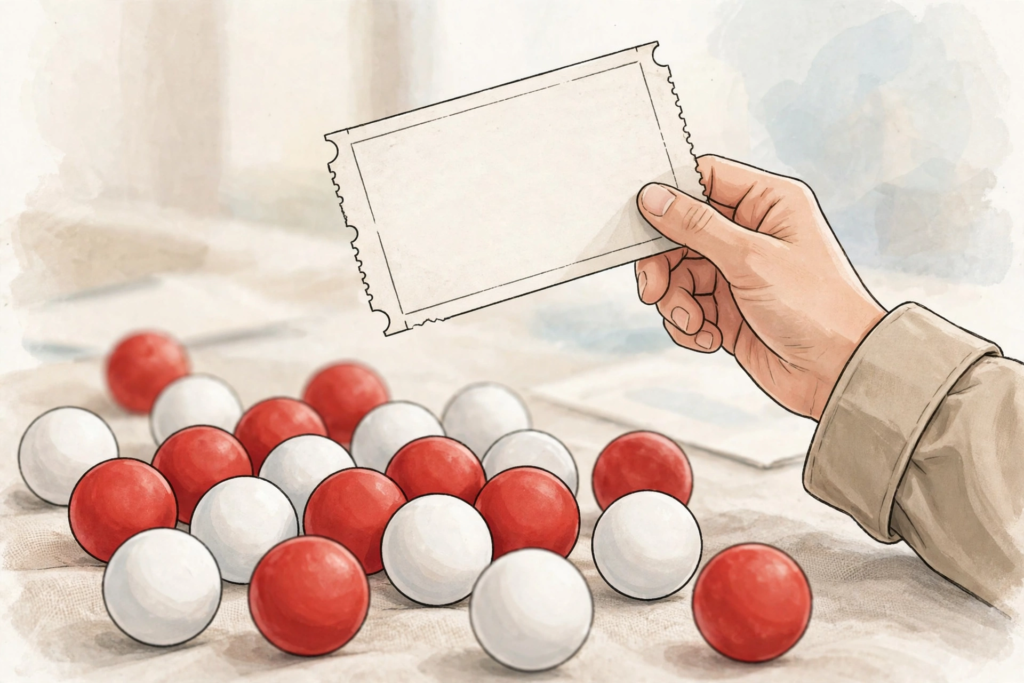
Powerball is one of the largest and best-known lotteries in the world. Played across 45 US states plus Washington D.C., Puerto Rico, and the U.S. Virgin Islands, it is famous for jackpots that regularly climb into the hundreds of millions of dollars — and, on rare occasions, past a billion. If you have ever wondered how the game actually works, this guide explains it from start to finish: how to pick your numbers, when the draws happen, what each prize tier pays, how Power Play works, and what the odds really mean.
18+ only in most jurisdictions. Play responsibly and only with money you can afford to lose. A lottery ticket is entertainment, never an investment or a way to make money.
What Is Powerball?
Powerball is a multi-state lottery run in the United States under common game rules, coordinated through the Multi-State Lottery Association and the participating state lotteries. Because ticket sales from many states feed into a single prize pool, the jackpot can grow far faster than a single-state game ever could. The game launched in its current form in 1992 and has been reshaped several times since, most notably in October 2015, when the number matrix changed to its present format and made the jackpot harder to win — which is exactly why jackpots now grow so large.
Each play is a single line of numbers. You are not buying a share in a draw or betting on an outcome; you are entering a set of numbers into an official draw, and the draw decides the result. Every combination has exactly the same chance of being drawn, whether it is a row of birthdays, a neat sequence, or a random Quick Pick.
How to Play Powerball: Step by Step
Playing Powerball is straightforward, and the whole process takes only a few minutes once you know the format.
Step 1: Pick five white ball numbers
Choose five different numbers from 1 to 69. These are the white balls, drawn from one machine. The order in which they are drawn does not matter for your ticket — matching all five in any order is what counts.
Step 2: Pick one Powerball number
Choose one number from 1 to 26. This is the red Powerball, drawn from a separate machine. The Powerball is the key to the jackpot: you must match all five white balls and the Powerball to win it.
Step 3: Decide whether to add Power Play
For an extra $1 per play in participating jurisdictions, you can add Power Play, which multiplies most non-jackpot prizes. We explain it in detail below.
Step 4: Choose your draws and pay
A standard play costs $2. You can enter a single draw or, where offered, play the same numbers for several consecutive draws in advance. Ticket sales close shortly before each draw, so buy early if you want to be sure of entering a particular night.
Step 5: Check your ticket after the draw
Compare your numbers with the drawn numbers. Keep your ticket safe until you have checked it — a paper ticket is a bearer instrument in most jurisdictions, meaning whoever holds it can claim on it, so signing the back of a winning ticket straight away is a widely recommended precaution.
When Are the Powerball Draws?
Powerball draws take place three times a week: every Monday, Wednesday, and Saturday at 10:59 p.m. Eastern Time, from the draw studio in Tallahassee, Florida. Results are published by the participating lotteries shortly after each draw. If nobody wins the jackpot, it rolls over to the next draw, growing with each rollover until someone matches all six numbers.
Powerball Prize Tiers Explained
Powerball has nine prize tiers. The jackpot is a pari-mutuel prize, meaning it is shared if more than one ticket matches all six numbers, while the lower tiers pay fixed amounts (except where Power Play changes them). Here is the standard prize table:
| White balls matched | Powerball matched | Standard prize |
|---|---|---|
| 5 | Yes | Jackpot |
| 5 | No | $1,000,000 |
| 4 | Yes | $50,000 |
| 4 | No | $100 |
| 3 | Yes | $100 |
| 3 | No | $7 |
| 2 | Yes | $7 |
| 1 | Yes | $4 |
| 0 | Yes | $4 |
Note that published prize tables can vary slightly by jurisdiction and over time, and some states have their own variations, so always check the official prize table for the lottery where you play. The smallest prize — matching only the Powerball — is $4, which is double the $2 cost of a play. Everything above that is a genuine profit on that line, but most lines win nothing at all.
What Is Power Play?
Power Play is an optional add-on, usually $1 extra per play, available in most participating jurisdictions (California is a notable exception, where it is not offered in the same form). Before each draw, a separate Power Play multiplier is drawn: 2x, 3x, 4x, 5x, or, when the advertised jackpot is below a set threshold, 10x.
If you added Power Play and win a non-jackpot prize, that prize is multiplied by the drawn multiplier — with one exception. The $1,000,000 second prize is always multiplied to $2,000,000 with Power Play, regardless of the multiplier drawn. The jackpot itself is never multiplied.
Is Power Play worth it? It depends on what you value. It raises the cost of a play from $2 to $3, a 50% increase, in exchange for multiplying smaller prizes. It does not change your odds of winning anything. If you enjoy the game and the extra dollar fits comfortably within a budget you set in advance, it adds excitement; if you are counting every dollar, the base game gives you the same jackpot chance for less.
How Powerball Jackpots Grow: Rollovers
The advertised jackpot starts at an estimated $20 million. If no ticket matches all six numbers, the jackpot rolls over and grows, funded by ticket sales from the next draw. Because Powerball sells tickets across so many states, a long rollover streak can add tens of millions per draw, which is how jackpots reach the billion-dollar headlines.
It is worth understanding the advertised jackpot figure. It is the estimated value of the annuity option: 30 graduated annual payments over 29 years. Winners can usually choose instead a one-off cash lump sum, which is smaller — roughly half the advertised figure in many cases — because it is the present cash value of that annuity. Both options are taxable at federal level in the US, and state taxes vary. This is general information only, not tax advice, and anyone facing a large win should take professional advice before choosing.
Powerball Odds: What the Numbers Really Mean
The odds of winning the Powerball jackpot with a single play are 1 in 292,201,338. The odds of winning any prize are about 1 in 24.9. Those two figures tell very different stories, and both matter.
The “any prize” figure sounds encouraging, but most of those wins are the $4 prize for matching only the Powerball. The odds of the second prize — matching all five white balls without the Powerball — are about 1 in 11.7 million. In other words, small prizes are relatively common, life-changing prizes are extraordinarily rare, and no pattern of play changes that.
Buying more lines does improve your chances, but only in direct proportion to what you spend: ten different lines give you ten chances in 292 million, which is still about 1 in 29 million. That is the honest arithmetic of the game, and it is why treating Powerball as entertainment — with a fixed, affordable budget — is the only sensible approach.
Quick Pick vs Choosing Your Own Numbers
You can pick your own numbers or ask for a Quick Pick, where the terminal generates random numbers for you. Statistically, both have identical odds — every combination is equally likely to be drawn. The practical differences are about convenience and sharing. Quick Picks are fast and avoid the trap of picking only numbers from 1 to 31 (birthdays and anniversaries), which many players do. That does not change your chance of winning, but if a birthday-heavy combination ever did win, it would be more likely to be shared with other birthday pickers. Random-looking combinations are no more likely to win, but they are less likely to be duplicated by other players.
One thing no strategy can do is make a number “due.” Draws are independent events: a ball that has not appeared for months has exactly the same chance as any other ball in the next draw. Systems that claim otherwise are selling a story, not an edge.
Common Mistakes New Powerball Players Make
Playing the same numbers without checking
Loyal numbers are fine, but only if you actually check them after every draw. Prizes go unclaimed every year because tickets were forgotten, lost, or never checked.
Spending more when the jackpot grows
A bigger jackpot does not improve your odds per line. Raising your spend because the jackpot is huge is the most common way a small entertainment budget quietly becomes a large one. Set your limit before you look at the jackpot figure, not after.
Forgetting the claim deadline
Claim periods vary by state, commonly 90 days to one year from the draw date. Check the rules where you bought the ticket, and do not leave a large win to the last week — paperwork, especially for a jackpot, takes time.
Losing the ticket
Sign the back of a paper ticket as soon as you buy it, photograph it for your own records, and store it somewhere safe. A lost unsigned ticket is very difficult to claim on.
How Powerball Winnings Are Claimed
Small prizes are usually paid at the retailer where the ticket was bought, up to a limit set by each lottery. Larger prizes are claimed at a lottery claim centre or by mail, with identity checks and, for the biggest prizes, a longer verification process. Jackpot winners choose between the annuity and the cash option within a deadline set by their state lottery. Again, rules differ by jurisdiction, so the lottery that sold your ticket is the authoritative source.
Frequently Asked Questions
How much does a Powerball ticket cost?
A standard Powerball play costs $2. Adding Power Play costs an extra $1 per play in participating jurisdictions, and an optional Double Play entry, where offered, costs another $1.
What numbers do I pick for Powerball?
Five white ball numbers from 1 to 69 and one red Powerball number from 1 to 26. You win the jackpot by matching all six in a single play line.
When are Powerball draws held?
Every Monday, Wednesday, and Saturday at 10:59 p.m. Eastern Time. Ticket sales close shortly before each draw.
What are the odds of winning the Powerball jackpot?
About 1 in 292,201,338 per play. The odds of winning any prize are about 1 in 24.9, but most of those wins are the $4 prize for matching only the Powerball.
Does Power Play multiply the jackpot?
No. Power Play multiplies non-jackpot prizes only. The $1,000,000 second prize is doubled to $2,000,000 with Power Play, and other non-jackpot prizes are multiplied by the drawn multiplier of 2x, 3x, 4x, 5x, or 10x where available.
Conclusion
Powerball is simple to play and easy to understand once you know the format: five numbers from 1 to 69, one Powerball from 1 to 26, three draws a week, nine prize tiers, and an optional Power Play multiplier for non-jackpot prizes. Its jackpots are enormous precisely because the odds are so long, so the smart way to enjoy it is as a small, fixed entertainment expense — pick your numbers, check your ticket, and never spend money you need for something else. Played that way, Powerball is a few dollars of excitement three nights a week, and nothing more.
18+ only in most jurisdictions. Play responsibly. If gambling stops being fun, or you feel you cannot control your spending, seek help from a local problem-gambling support service.
Pingback: SuperEnalotto Lottery Guide: How to Play Italy's Biggest Lottery