
- The Short Answer
- The Basics Side by Side
- Ticket Price: Where the Real Difference Starts
- The Odds, Honestly
- Prize Structure: What Happens Below the Jackpot
- Draw Days and the Weekly Rhythm
- Multipliers: Power Play vs the Built-In Multiplier
- Lump Sum, Annuity, and Tax (the Same Either Way)
- Which Game Should You Play?
- Frequently Asked Questions
The Short Answer
If you want the honest answer to Powerball vs Mega Millions in one sentence: per ticket, Mega Millions has very slightly better jackpot odds; per dollar, Powerball gives you more chances, because its ticket costs less than half as much. Everything else is detail — and the detail is worth knowing, because the two games feel different to play even though their jackpots look the same on the news.
This guide compares the two games on the things that actually affect your experience: price, format, draw days, odds, and what the smaller prizes look like. It contains no winning numbers, no results, and no ticket-purchase links. Play only if you are of legal age where you live. 18+ only — play responsibly.
The Basics Side by Side
Powerball is the older game, launched in its current multi-state form in the early 1990s and now sold in 45 states plus Washington DC, Puerto Rico, and the US Virgin Islands. Mega Millions came a few years later and is sold in nearly all the same places. Both are drawn with two sets of numbers: five main numbers from one pool, plus one bonus number from a second pool. Match all six and you win the jackpot.
Here is the side-by-side picture as of the current game rules:
| Feature | Powerball | Mega Millions |
|---|---|---|
| Ticket price | $2 per play | $5 per play |
| Main numbers | 5 from 1 to 69 | 5 from 1 to 70 |
| Bonus number | 1 Powerball from 1 to 26 | 1 Mega Ball from 1 to 24 |
| Draw days | Monday, Wednesday, Saturday | Tuesday, Friday |
| Draw time | 10:59 p.m. Eastern | 11:00 p.m. Eastern |
| Jackpot odds | About 1 in 292.2 million | About 1 in 290.5 million |
| Odds of any prize | About 1 in 24.9 | About 1 in 23.1 |
| Multiplier | Power Play, +$1, optional | Built into the $5 price |
The formats look almost identical, and the odds are close enough that the difference barely matters in real life. But the price difference changes the maths in a way most comparisons skip over, so let us start there.
For the official rules of each game, the state lottery pages are the most reliable source. Colorado’s lottery explains Powerball’s format plainly: https://www.coloradolottery.com/en/games/powerball/its-easy-to-play/ — and New Mexico’s lottery does the same for Mega Millions: https://www.nmlottery.com/games/mega-millions/how-to-play-mega-millions/

Ticket Price: Where the Real Difference Starts
A Powerball ticket costs $2. A Mega Millions ticket costs $5, after Mega Millions raised its price in April 2025 and rebuilt the game around it. That $3 gap is the single biggest practical difference between the two games.
Think about it with a fixed weekly budget, because that is how most people actually play. With $10 a week, you can buy five Powerball tickets or two Mega Millions tickets. Five Powerball entries give you five shots at a jackpot with odds of roughly 1 in 292 million each. Two Mega Millions entries give you two shots at slightly better odds of roughly 1 in 290 million each. On total jackpot probability per dollar, Powerball comes out ahead — not by a little, but by more than double, because you simply get more entries.
That does not make Powerball “better” in every sense. Mega Millions justifies its higher price with a built-in multiplier on every ticket and bigger starting non-jackpot prizes. But if your question is “which game gives me the most jackpot chances for my money,” the answer is Powerball, and it is not close.
A related point: the $2 versus $5 gap also changes how a casual habit adds up. Ten dollars a week on Powerball is $520 a year. The same habit on Mega Millions is $1,300 a year. Neither amount will make or break most budgets, but if you play both games every draw, the yearly total climbs fast. Set a number you are comfortable with first, then choose the game that fits it — not the other way round.
The Odds, Honestly
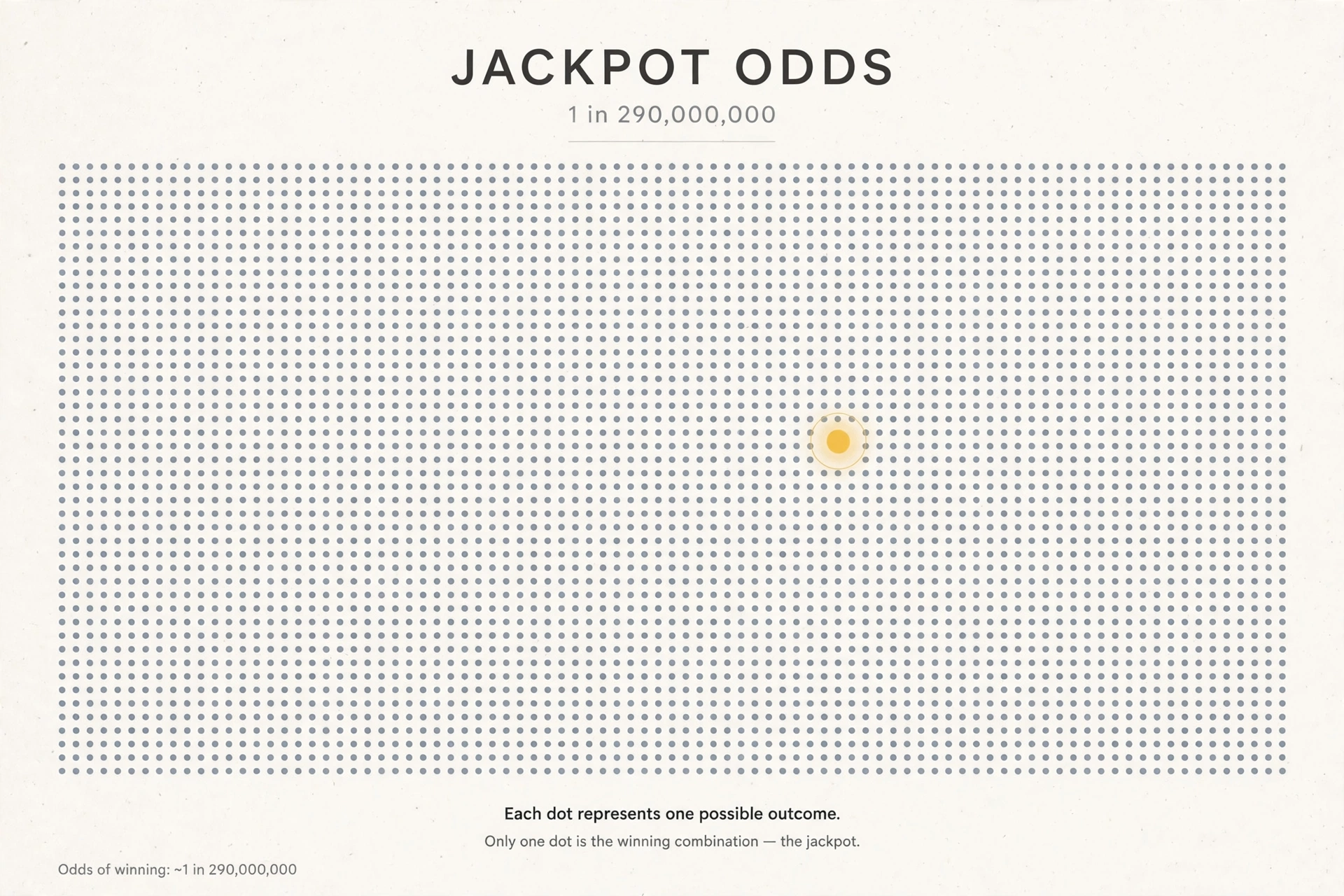
Let us be straight about what these odds mean. One in 292 million and one in 290 million are, for any practical purpose, the same number: effectively impossible for any individual ticket. You are more likely to be struck by lightning, several times over, than to win either jackpot with a single ticket. The 0.6% edge Mega Millions holds on jackpot odds is real arithmetic and meaningless luck.
Where the odds do differ in a way you might actually feel is the chance of winning any prize at all. Mega Millions sits around 1 in 23, Powerball around 1 in 25. That means, on average, a Mega Millions player sees some kind of small win slightly more often. Neither figure means you will win regularly — it means that over a long stretch of tickets, roughly one in 23 or one in 25 returns something. Most of those returns are the smallest tier, worth less than or barely more than the ticket price.
A detailed tier-by-tier odds comparison, computed from the published game rules, is useful if you want the full table rather than the headline numbers: https://lotterynumberlab.com/guides/mega-millions-vs-powerball-odds.html
One myth worth killing here: no set of numbers is luckier than any other. Birthdays, patterns, “hot” numbers, and quick picks all face exactly the same odds. The only thing that changes your probability is buying more tickets, and even that moves it from “almost zero” to “still almost zero.” If you enjoy picking your own numbers, do it for fun — just do not pay anyone who claims their system improves your chances. Our guide to lottery number generator tools explains why prediction claims fall apart.
Prize Structure: What Happens Below the Jackpot
Jackpots dominate the news, but most players’ actual experience is the lower tiers, so they deserve a closer look.
Powerball has nine prize tiers. The smallest prize, for matching just the Powerball, is $4 — double your $2 ticket. Match five main numbers without the Powerball and you are at $1 million before any multiplier. The tiers step up gradually, which means a decent night usually means a small win, not a life-changing one.
Mega Millions also has nine tiers, but the numbers are bigger across the board because the ticket costs more. Its smallest prize is $10, which is double the $5 ticket price. Match five main numbers without the Mega Ball and the base prize is $1 million — same as Powerball’s second tier — but remember that Mega Millions multiplies every non-jackpot prize automatically, so that tier never pays less than $2 million in practice.
The practical difference: a good night on Mega Millions tends to pay more in absolute dollars, while a good night on Powerball tends to return a higher multiple of what you spent. Which feels better depends on what you are playing for. If you want the occasional $20 or $50 win to keep things interesting, Mega Millions’ structure leans that way. If you want the cheapest possible shot at the big one, Powerball leans the other way.
Draw Days and the Weekly Rhythm
Powerball draws three times a week — Monday, Wednesday, and Saturday — while Mega Millions draws twice, on Tuesday and Friday. That extra draw day is a small but real difference in how the games feel.
Three draws a week means the jackpot rarely sits still for long. It also means more chances to play, which cuts both ways: more fun if you enjoy following the game, more spending if you buy a ticket for every draw without thinking about it. Two draws a week gives Mega Millions a slightly slower rhythm, and its jackpots tend to build for a day longer between draws.
Timing matters in another way that catches people out: the sales cutoff. Tickets stop selling well before the draw itself, and the cutoff varies by state. A ticket bought after the cutoff counts for the next draw, not the one about to happen. Our guide to lottery draw schedules and time zones covers cutoffs and time zone conversions in detail, and it is worth reading before you assume a late ticket made tonight’s draw.
Multipliers: Power Play vs the Built-In Multiplier
This is where the two games’ philosophies show most clearly.
Powerball’s Power Play is optional: pay an extra $1 per ticket and your non-jackpot prizes get multiplied by a randomly drawn number from 2x to 10x. A $50,000 prize becomes $100,000 at 2x, or $500,000 at 10x. It does not multiply the jackpot, and it is not available in California, where prizes must be pari-mutuel by law.
Mega Millions builds its multiplier into every ticket. When you buy a $5 play, a multiplier from 2x to 10x is randomly assigned to it at no extra cost, and it applies to all non-jackpot prizes. There is no decision to make and no extra dollar to add. The trade-off is that you cannot opt out of paying for it — the $5 price includes it whether you care about multipliers or not.
Which is better? If you like choosing, Powerball’s optional add-on gives you control. If you like simplicity, Mega Millions’ built-in version means you never have to think about it. In expected-value terms, the two approaches land in roughly the same neighbourhood once you account for the price difference. Do not let a multiplier be the reason you pick a game — it is a garnish, not the meal.
Lump Sum, Annuity, and Tax (the Same Either Way)
Both games pay jackpots the same way: an annuity spread over 30 yearly payments, or a lump sum worth roughly half the advertised jackpot. Both are taxed the same way too — US federal tax as ordinary income, with 24% withheld on prizes over $5,000 and a further bill at filing time for most big winners, plus state tax where it applies.
In other words, the tax and payout choice does not help you pick between the games, because it is identical for both. What does matter is understanding it before you win, since the lump sum versus annuity decision is hard to undo. Our guide to lottery winnings tax walks through the US, UK, and India systems with worked examples.
One difference worth noting for group players: if you play in a pool, the claiming and tax paperwork depends on documentation made before the draw, whichever game you play. Our family lottery pool rules guide covers that in full.
Which Game Should You Play?
Here is how I would actually decide, and it is simpler than most comparisons make it.
Pick Powerball if: you want the most jackpot chances per dollar, you like three draws a week, you prefer a $2 ticket, or you want the option to add a multiplier only when you feel like it.
Pick Mega Millions if: you want slightly better odds per ticket, you prefer bigger small prizes, you like the multiplier being automatic, or you play once or twice a week and the $5 ticket does not bother you.
Pick neither every draw if: the habit is costing more than you are comfortable with. Both games are entertainment with a negative expected return, and the honest expected value of a ticket is well under its price. That is fine if the fun is worth the price to you — it is a problem only when the spending stops being a choice.
And if you genuinely cannot decide, there is nothing wrong with playing whichever jackpot is bigger that week. The games are close enough that the jackpot size is as good a tiebreaker as any, and it keeps the whole thing fun instead of turning it into homework.
Frequently Asked Questions
Which has better odds, Powerball or Mega Millions?
Per ticket, Mega Millions has slightly better jackpot odds: about 1 in 290.5 million versus Powerball’s 1 in 292.2 million. Per dollar, Powerball wins, because its ticket costs $2 against Mega Millions’ $5.
How much does a Powerball ticket cost?
$2 per play, with an optional $1 Power Play add-on that multiplies non-jackpot prizes.
How much does a Mega Millions ticket cost?
$5 per play, with a multiplier from 2x to 10x built into every ticket at no extra cost.
How many times a week are Powerball and Mega Millions drawn?
Powerball draws three times a week: Monday, Wednesday, and Saturday. Mega Millions draws twice a week: Tuesday and Friday.
What is the smallest prize in each game?
Powerball’s smallest prize is $4 for matching just the Powerball. Mega Millions’ smallest prize is $10, which is double the ticket price.
Do Powerball and Mega Millions pay lump sum or annuity?
Both offer the choice: a 30-year annuity or a lump sum worth roughly half the advertised jackpot. Both are taxed as ordinary income in the US.
Can I play both games?
Yes, and many people do. Just keep an eye on the total weekly spend — playing both games every draw adds up faster than playing one.
The Bottom Line on Powerball vs Mega Millions
Powerball vs Mega Millions is not a contest with a clear winner, because the games are built for slightly different players. Powerball is the cheaper, more frequent game with more jackpot chances per dollar. Mega Millions is the pricier game with better per-ticket odds and bigger small prizes. The jackpot odds are so close that they should not decide anything for you — price, draw days, and how much fun you have following the game should.
Whichever you pick, set a budget, know the sales cutoff, and keep the ticket safe until you have checked it against the official source. And if you play with family or friends, sort the pool rules out before the draw, not after a win — our family pool guide shows exactly how.
Play only if you are of legal age where you live. Set a budget, keep it fun, and never chase losses. 18+ only. Play responsibly.