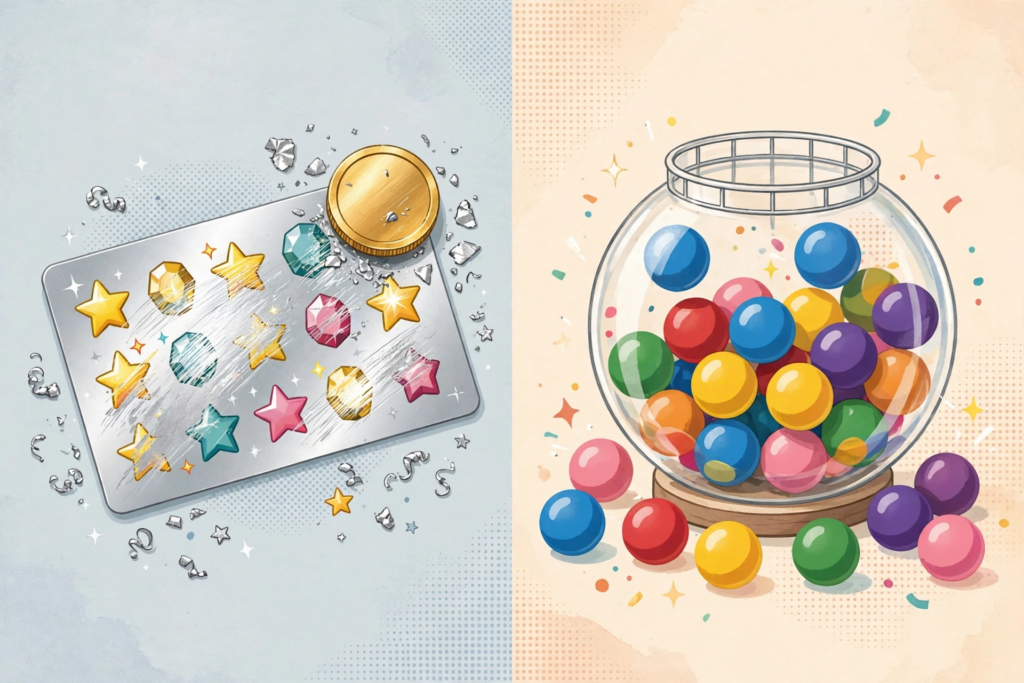
Walk into almost any shop that sells lottery products and you face two very different kinds of game: the draw, where you pick numbers and wait for a weekly draw, and the scratch card, where you scratch a coating and know instantly whether you have won. Both are games of chance run by lottery operators, both pay back less than players spend as a group, and neither can be beaten by a system. But they differ sharply in how their odds work, how often they pay, how big their prizes are, and how quickly they can eat through a budget. This guide compares them honestly so you can choose the kind of game you actually enjoy — at a cost you set in advance.
You must be of legal gambling age in your jurisdiction (18+ in most places) to play. Play responsibly and only with money you can afford to lose. Neither game is a way to make money.
How a Lottery Draw Works
In a draw game such as Powerball or UK Lotto, you choose a set of numbers (or take a random Quick Pick or Lucky Dip) and wait for the draw, usually once or twice a week. A machine draws the winning numbers at random, and prizes are paid according to how many of your numbers match. The odds are fixed by the game’s matrix — the size of the number pool and how many numbers you must match. Powerball’s jackpot odds, for example, are 1 in 292,201,338, because that is how many combinations of five numbers from 1 to 69 plus one from 1 to 26 exist. The odds never change from draw to draw, no matter how many tickets are sold or how long it has been since the jackpot was last won.
Draw games concentrate most of their prize money in the jackpot. Lower tiers exist, and in a game like Powerball about 1 in 24.9 plays wins something, but most of those wins are small. The trade-off is clear: a very small chance of a very large prize, with long stretches of winning nothing in between.
How a Scratch Card Works
A scratch card is an instant-win game. A fixed number of cards is printed for each game, with a fixed set of prizes built into the run — including a set number of top prizes. When you buy a card, the prize (or lack of one) is already printed under the coating. Scratching simply reveals it. There is no draw, no waiting, and no second chance to influence the result.
Because the prize pool is fixed at printing, the overall odds of a game are published when it launches — commonly around 1 in 3 to 1 in 5 for winning any prize, depending on the game and price point. But those odds shift as the game sells: if most of the top prizes have already been claimed, the remaining cards are worse value than the printed odds suggest. Many lotteries publish “remaining prizes” data online, so you can check whether a game’s top prizes are still unclaimed before buying.
Odds Compared: Winning Something vs Winning Big
This is where the two games genuinely diverge, and it is the most important comparison in this guide.
Winning anything
Scratch cards win here, by a wide margin. Typical overall odds of winning any prize on a scratch card are around 1 in 3 to 1 in 5, against about 1 in 24.9 for any Powerball prize and about 1 in 4.9 for any prize on a UK Lotto line under its two-round format. If your enjoyment comes from winning something fairly often, scratch cards deliver that feeling far more frequently.
There is a catch, and it matters: most scratch card wins are small, frequently no more than the price of the card itself. A “win” that returns your stake is not a profit, and a run of break-even cards still costs you the price of every losing card in between.
Winning a life-changing prize
Draw games win here, just as clearly. A draw jackpot can run into hundreds of millions — Powerball’s record jackpot was $2.04 billion — while even the largest scratch card top prizes typically top out at $10 to $25 million in the US, and far less in the UK, where top scratch card prizes are commonly in the tens of thousands of pounds. Scratch card top-prize odds are much better than draw jackpot odds — often around 1 in 1 to 2 million rather than 1 in 292 million — but the prize itself is in a different league. If your dream is a nine-figure sum, only a draw game offers it, and the odds reflect that.
Payout Rates: How Much Comes Back as Prizes
The payout rate is the share of total ticket revenue returned to players as prizes. Scratch cards typically return 60% to 80% of revenue, with higher-priced cards paying back more: roughly 50% to 60% on $1 to $2 cards, 65% to 75% on $5 to $10 cards, and 75% to 85% on $20 to $30 cards. Draw games return less: Powerball’s prize fund is roughly 50% of sales, and UK Lotto’s prize fund is also around half of the money taken, with the rest going to good causes, duty, retailers, and operating costs.
On a per-dollar basis, then, a well-chosen higher-priced scratch card returns more in prizes than a draw ticket. But “returns more” still means “returns less than you spent.” A 75% payout rate means players as a group lose 25 cents of every dollar, and no individual player can expect to beat that average over time.
Speed and Budget: The Hidden Difference
The most important practical difference between the two games is not odds or prizes — it is speed. A draw ticket costs a fixed amount once or twice a week, and then the game is over until the next draw. You cannot accidentally buy fifty draw entries in five minutes. A scratch card takes seconds to play, and the next one is right there in the shop or one tap away online. That speed makes it easy to spend far more than intended in a single session, especially because small wins feel like encouragement to keep going.
Digital instant-win games play even faster than paper cards, so limits matter more online, not less. If you play scratch cards, the single most useful rule is to decide your spend before you start — a fixed number of cards, or a fixed amount of money — and stop when it is gone, win or lose. Chasing a loss with “just one more card” is how a small entertainment spend becomes a large one.
Can You Improve Your Chances at Either Game?
Honestly, no — not in any way that matters. For draw games, every combination has the same chance, past draws have no effect on future draws, and buying more lines only increases your chances in direct proportion to your spend. For scratch cards, the prizes are printed before sale, so no shop, time of day, or position in a roll makes a card more likely to win. Checking which games still have unclaimed top prizes tells you what you could win, not whether you will win it. Anyone selling a system for either game is selling a story.
One genuine choice does affect your expected return on scratch cards: the price tier. Higher-priced cards generally pay back a higher percentage, so if you are going to play scratch cards anyway, one $10 card is usually better value than ten $1 cards — and it is also much easier to keep track of. The same logic does not apply to draws, where a $2 line and a $10 bundle of lines differ only in how many chances you hold.
Side-by-Side Summary
| Scratch cards | Draw lotteries | |
|---|---|---|
| Result timing | Instant | Days later, on draw night |
| Odds of any prize | Often 1 in 3 to 1 in 5 | About 1 in 25 (Powerball) to 1 in 5 (UK Lotto, two rounds) |
| Top prize | Smaller, often up to low millions | Can reach hundreds of millions or more |
| Top-prize odds | Often 1 in 1–2 million | 1 in tens or hundreds of millions |
| Payout rate | Typically 60–80% | Typically around 50% |
| Speed of spending | Very fast — seconds per card | Slow — fixed draws per week |
| Main risk | Overspending in one session | Overspending when jackpots roll over |
Which Game Suits You?
Choose a scratch card if you enjoy instant results, like winning something fairly often even if it is small, and are confident you can stick to a fixed spend in a fast game. Choose a draw if you enjoy the anticipation, dream of a very large jackpot, and prefer a game that naturally limits how often you can play. Many regular players enjoy both, for different moods — a draw line for the week’s daydream, and an occasional scratch card for instant fun.
Neither choice makes you more likely to come out ahead. The house edge is built into both games, and the only decision that genuinely protects your money is the budget you set before you play, not the game you pick.
Frequently Asked Questions
Do scratch cards have better odds than the lottery?
Better odds of winning something, usually yes — commonly around 1 in 3 to 1 in 5, against about 1 in 25 for any Powerball prize. But most scratch card wins are small, often just the price of the card, while draw games offer far larger top prizes at far longer odds.
Can you tell which scratch card will win?
No. Prizes are printed before the cards are sold, and there is no way to tell from the outside which card wins. The shop, the time of day, and the position in a roll make no difference.
Do higher-priced scratch cards pay back more?
Generally yes, as a percentage of revenue. Higher-priced cards typically return 75% to 85%, against 50% to 60% for the cheapest cards. Check your lottery’s published data for the exact game, because figures vary by game and jurisdiction.
Which is better value, scratch cards or draws?
Neither pays back what players spend as a group. Scratch cards return a higher percentage and pay small prizes more often; draws offer much bigger top prizes at much longer odds. Choose for the kind of game you enjoy, at a cost you set in advance.
Are scratch cards more addictive than draws?
They can be riskier for overspending, because they play in seconds and small wins encourage continued play. If you play scratch cards, set a strict limit before you start and use deposit limits or time-outs if you play online.
Conclusion
Scratch cards and draw lotteries are the same idea in two very different shapes: one fast and frequent, the other slow and spectacular. Scratch cards give you more wins, smaller prizes, and a higher payout rate; draws give you a shot at a fortune, at odds so long that the jackpot is best treated as a daydream. Neither is an investment, neither can be beaten, and neither should ever be played with money you need. Pick the game whose pace and prizes you enjoy, set your limit before you start, and keep it an entertainment expense — that is the only strategy that actually works.
You must be of legal gambling age in your jurisdiction (18+ in most places) to play. Play responsibly. If gambling stops being fun, or you feel you cannot control your spending, seek help from a local problem-gambling support service.