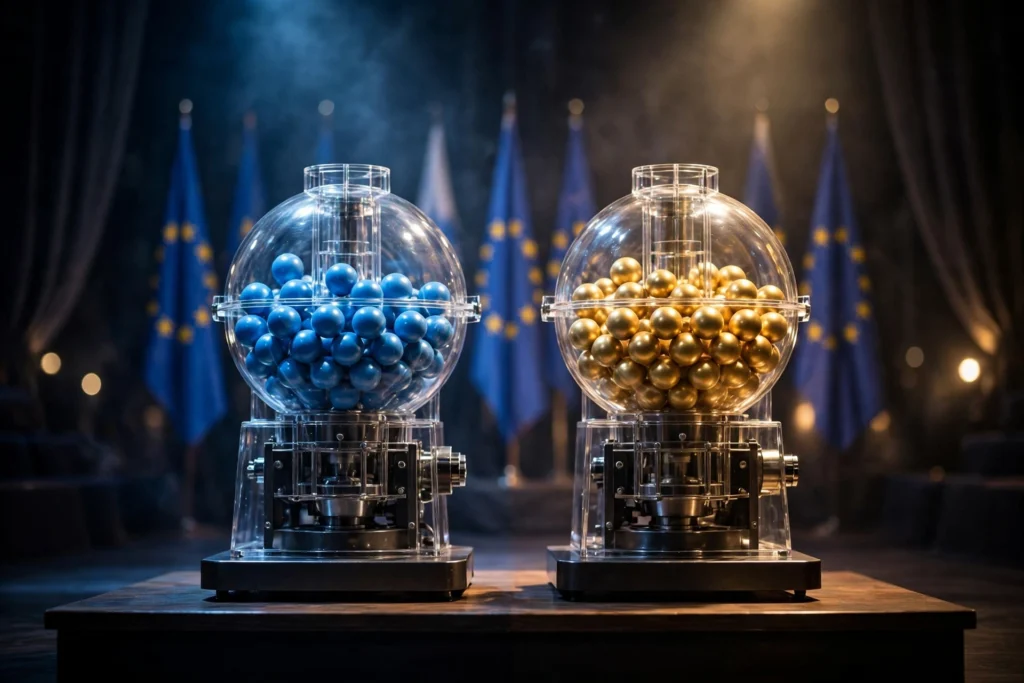
This Eurojackpot vs EuroMillions comparison explains the two biggest cross-border lotteries in Europe side by side: their formats, odds, jackpots, costs, draw days and the countries where you can play them. At first glance the two games look almost identical — both ask you to pick five numbers from 1 to 50 plus two bonus numbers from 1 to 12, both draw on Tuesdays and Fridays, and both share exactly the same jackpot odds of 1 in 139,838,160. But the games are run by different groups of national lottery operators, they are sold in different countries, and their jackpots behave very differently: Eurojackpot is capped at €120 million, while EuroMillions can reach €250 million. This guide lays out every difference that matters, so you can decide which game suits you. You must be 18 or older to play lottery games in the participating countries, and you should always play responsibly and only with money you can afford to lose.
Table of Contents:
- Eurojackpot vs EuroMillions at a Glance
- The Format: Identical on Paper
- Eurojackpot: The Younger Rival
- EuroMillions: The Older Giant
- Jackpots and Caps: €120 Million vs €250 Million
- Odds of Winning Any Prize: 1 in 32 vs 1 in 13
- Cost per Line and Where You Can Play
- Which Game Should You Play?
- Frequently Asked Questions
- Conclusion
Eurojackpot vs EuroMillions at a Glance
The table below summarises the two games. Everything in it comes from the published rules of the two games.
| Feature | Eurojackpot | EuroMillions |
|---|---|---|
| Launched | March 2012 | 2004 |
| Format | 5 from 1–50 + 2 Euro numbers from 1–12 | 5 from 1–50 + 2 Lucky Stars from 1–12 |
| Jackpot odds | 1 in 139,838,160 | 1 in 139,838,160 |
| Overall odds of any prize | About 1 in 32 | About 1 in 13 |
| Starting jackpot | €10 million | €17 million |
| Jackpot cap | €120 million | €250 million |
| Prize tiers | 12 | 13 |
| Draw days | Tuesday and Friday | Tuesday and Friday |
| Draw location | Helsinki, Finland | Paris, France |
| Cost per line | €2 in most countries | £2.50 in the UK, €2.50 in Ireland |
| Participating countries | 18–19 European countries | 9 countries |
The headline is that the two games are twins in format and odds, but very different in size. EuroMillions is the bigger game with the bigger jackpot and the better chance of winning something. Eurojackpot is the wider game, played in roughly twice as many countries, with a lower starting jackpot and a lower cap.
The Format: Identical on Paper
Both games use the same format: pick five main numbers from 1 to 50, then pick two bonus numbers from 1 to 12. Eurojackpot calls its bonus numbers Euro Numbers; EuroMillions calls them Lucky Stars. Because the arithmetic is identical, the jackpot odds are identical too: 1 in 139,838,160 in both games. That is a useful fact to remember when a website claims one game is “easier to win” than the other — for the jackpot, at least, the odds are exactly the same. The difference lies in the lower tiers: EuroMillions has 13 prize tiers and Eurojackpot has 12, and EuroMillions pays a prize for matching just two main numbers, while Eurojackpot’s smallest winning combination is two main numbers plus one Euro number. The order of the numbers never matters in either game, and a bonus number can be the same as one of your main numbers, because it comes from a separate pool. For a simple explanation of how lottery odds work in general, see our beginner’s guide.
Eurojackpot: The Younger Rival
Eurojackpot launched in March 2012, created by a group of European lottery operators to compete with EuroMillions. It is played in 18 to 19 countries, mostly in Central and Northern Europe, including Germany, Spain, Italy, the Netherlands, Sweden, Norway, Finland and Poland — more countries than any other European lottery. Draws take place every Tuesday and Friday evening in Helsinki, Finland, at about 20:00 CET. The format has changed once since launch: in March 2022 the Tuesday draw was added, the Euro numbers went from 2-from-10 to 2-from-12, and the jackpot cap was raised from €90 million to €120 million. That change also lengthened the jackpot odds from about 1 in 95 million to the current 1 in 139,838,160, so older articles quoting 1-in-95-million odds describe the old format. A Eurojackpot line costs €2 in most participating countries. The jackpot starts at €10 million, and there are 12 prize tiers. Read our full guide to the game here.

EuroMillions: The Older Giant
EuroMillions launched in 2004, created by the national lotteries of France, Spain and the United Kingdom, and it is the older and bigger of the two games. It is played in nine countries: the United Kingdom, Ireland, France, Spain, Portugal, Belgium, Luxembourg, Austria and Switzerland. Draws take place every Tuesday and Friday evening in Paris, at about 20:00 UK time, and the UK National Lottery shows the draw at 8:45 p.m. The format has been 5-from-50 plus 2-from-12 since 2016, when the Lucky Stars pool grew from 11 to 12 numbers. A line costs £2.50 in the UK — which also enters the player into the UK Millionaire Maker raffle, where at least one code wins £1 million in every draw — and €2.50 in Ireland. The jackpot starts at €17 million, and there are 13 prize tiers. EuroMillions has produced the largest lottery jackpots in European history, which is why it gets the most attention whenever its jackpot rolls. Read our full guide to the game here.

Jackpots and Caps: €120 Million vs €250 Million
The jackpot cap is the biggest structural difference between the two games. Eurojackpot’s jackpot is capped at €120 million. Once it reaches the cap, the jackpot stops growing, and any extra money that would have gone to the top prize flows down into the lower prize tiers instead — usually the second tier, for matching five main numbers and one Euro number. The jackpot then waits at €120 million until somebody matches all seven numbers. EuroMillions’ jackpot is capped at €250 million, more than twice as high. Once it reaches its cap, it can stay there for a set number of draws, and then a must-be-won draw is held, so the money is eventually paid out to the best matching tickets even if nobody matches all seven numbers. The result is that EuroMillions jackpots can grow far larger — past €200 million is common during a long rollover run — while Eurojackpot jackpots top out sooner but reach their cap more often. If the size of the headline prize is what excites you, EuroMillions wins this round by a wide margin.
Odds of Winning Any Prize: 1 in 32 vs 1 in 13
The jackpot odds are identical, but the odds of winning any prize are not. In EuroMillions, the overall odds of winning something are about 1 in 13, because the game pays a prize for matching just two main numbers. In Eurojackpot, the overall odds are about 1 in 32, because its smallest prize needs two main numbers plus one Euro number. That is a large difference in practice: a EuroMillions player can expect a small win roughly two and a half times as often as a Eurojackpot player. The trade-off is that EuroMillions’ small prizes are correspondingly smaller on average. Neither game’s odds change with the numbers you pick, the day you play, or how many tickets you buy beyond the simple fact that more lines mean more chances. Every combination has exactly the same chance in every draw, and past results never influence the next draw. If you want frequent small wins to keep the game interesting, EuroMillions is the better fit; if you are only interested in the jackpot, the two games are equal.
Cost per Line and Where You Can Play
A Eurojackpot line costs €2 in most participating countries, though the exact price varies slightly by country. A EuroMillions line costs £2.50 in the UK and €2.50 in Ireland, with prices in other countries set by the local operator. The most important practical difference is availability: the two games are sold in largely different countries, and they overlap only in Spain. Eurojackpot is not sold in the UK, and EuroMillions is not sold in Germany — so for most players, the choice is made by where they live. Both games can only be entered in a participating country, and prizes must be claimed in the country where the ticket was bought. A ticket bought in France cannot be claimed in the UK, and a ticket bought in Germany cannot be claimed in Spain. Always check the rules of the operator in your own country before playing, including the minimum age, which is 18 in all participating countries. We compared two other European games in a similar way here.
Which Game Should You Play?
There is no objectively better game — it depends on what you want. Choose EuroMillions if you want the biggest possible jackpot, the best chance of winning any prize, and the must-be-won draw that guarantees the money is eventually paid out. Choose Eurojackpot if you live in one of its 18 or 19 countries, you prefer a cheaper €2 line, and you like a game whose jackpot reaches its cap more often and therefore produces jackpot winners more regularly. Both games draw on the same two nights, both give you the same 1-in-139,838,160 shot at the jackpot, and both are run by regulated national lottery operators with audited draws. The honest advice is the same for either game: treat it as entertainment, set a budget before you play, never chase losses, and remember that the odds are fixed — no system, pattern or “hot number” strategy can change them.
Frequently Asked Questions
Do Eurojackpot and EuroMillions have the same odds?
Yes, for the jackpot. Both games use the same format — 5 numbers from 1 to 50 plus 2 bonus numbers from 1 to 12 — so the jackpot odds are identical at 1 in 139,838,160. The overall odds of winning any prize differ: about 1 in 13 for EuroMillions and about 1 in 32 for Eurojackpot.
Which has the bigger jackpot, Eurojackpot or EuroMillions?
EuroMillions. Its jackpot starts at €17 million and is capped at €250 million, while Eurojackpot starts at €10 million and is capped at €120 million.
Are Eurojackpot and EuroMillions the same game?
No. They are separate games run by different groups of national lottery operators, with separate draws, separate prize pools and different participating countries. They only share the same number format.
When are Eurojackpot and EuroMillions draws held?
Both games draw on Tuesdays and Fridays. Eurojackpot draws in Helsinki at about 20:00 CET, and EuroMillions draws in Paris at about 20:00 UK time.
Can you play Eurojackpot in the UK?
No. Eurojackpot is not sold in the United Kingdom. UK players who want a similar game should play EuroMillions, which is sold by the National Lottery.
What happens when the Eurojackpot jackpot reaches €120 million?
The jackpot stops growing and any extra money flows down into the lower prize tiers, usually the second tier. The jackpot then waits at €120 million until somebody matches all seven numbers.
Conclusion
Eurojackpot and EuroMillions are twins in format and odds but very different in scale. EuroMillions is the older, bigger game: a €17 million starting jackpot, a €250 million cap, 13 prize tiers, and overall odds of about 1 in 13. Eurojackpot is the wider game: played in roughly twice as many countries, a €2 line, a €10 million starting jackpot, a €120 million cap, and overall odds of about 1 in 32. For most players the choice is made by geography, since the games are sold in different countries and overlap only in Spain. Whichever game you can play, the rules are the same: pick five numbers and two bonus numbers, check the official results after the Tuesday or Friday draw, and claim in the country where you bought the ticket. And whatever game you play, remember the basics: you must be 18 or older, set a budget before you play, and play responsibly — the lottery is entertainment, not a way to make money.