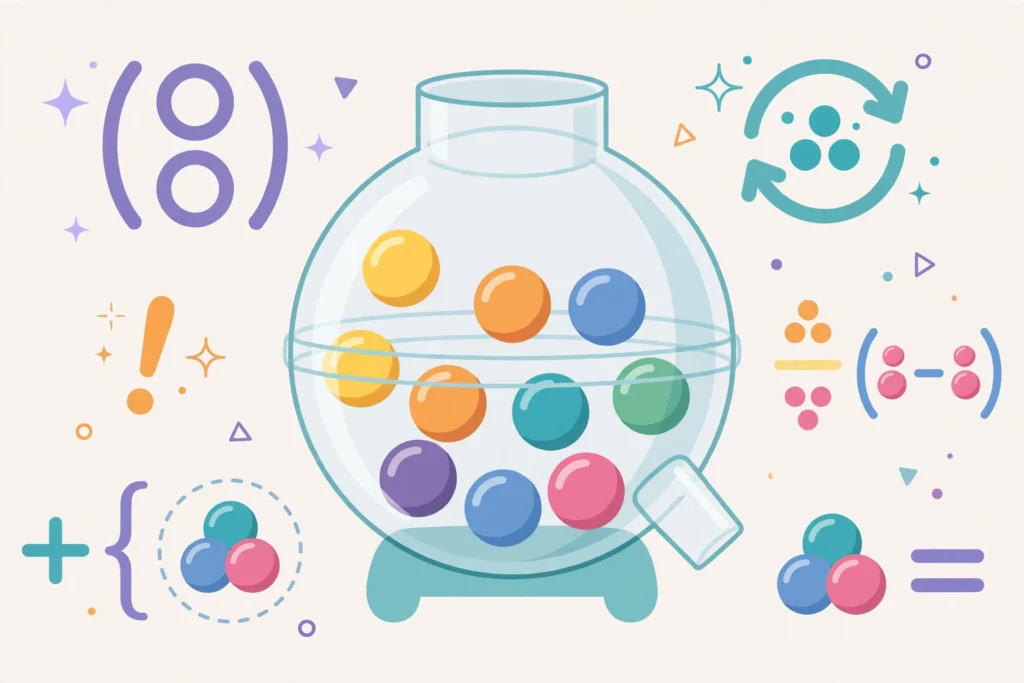
If you have ever looked at a lottery ticket and wondered what “1 in 292 million” actually means, you are not alone. Lottery odds are quoted everywhere, yet they are rarely explained in a way that helps a normal player picture them. This guide does exactly that: it explains lottery odds for beginners, in plain language, with real examples from major games.
You will learn how odds are calculated, why “1 in 292 million” does not mean what most people think it means, how prize tiers work, and why buying more tickets changes your chances less than you might expect. No maths degree is needed. If you can follow a simple counting example, you can follow this guide.
It is general information only, not financial advice. Lottery rules and odds differ by game, so always check the official rules for the game you are playing. You must be 18 or over to play the lottery in most places, and you should always play responsibly and only with money you can afford to spend on entertainment. If playing ever stops feeling fun, take a break and seek support from a responsible-gambling organisation.
Table of Contents
- What Are Lottery Odds?
- How Lottery Odds Are Calculated
- What “1 in 292 Million” Really Means
- Prize Tiers: Why Smaller Prizes Are Easier to Win
- Does Buying More Tickets Help?
- Common Lottery Odds Myths
- Frequently Asked Questions
- Conclusion
What Are Lottery Odds?
When a lottery says the odds of winning the jackpot are “1 in 292 million,” it means this: out of all the possible number combinations that could be drawn, exactly one combination wins the jackpot. If every possible combination were sold once, exactly one ticket would hold the jackpot combination. The other 292,201,337 tickets would not.
That is the simplest way to think about lottery odds. Odds are a count of possibilities. They are not a prediction, a feeling, or a measure of how hard you try. They are simply the number of different tickets that could exist, compared with the number of those tickets that win a particular prize.
It helps to keep two ideas separate:
- Probability is the chance that a particular event happens. If there are 292 million possible combinations and one wins, the probability of a single ticket winning is 1 divided by 292 million — a very small number.
- Odds are usually quoted in the form “1 in X,” which is just another way of expressing that same probability. “1 in 292 million” means one winning outcome for every 292 million possible outcomes.
In everyday language, people often say “the odds are against me” when they mean the probability is low. That is fine, as long as you remember the underlying point: a lottery draw is random, and every combination has the same chance as every other combination.
How Lottery Odds Are Calculated
Lottery odds come from counting combinations. Take Powerball, one of the best-known examples, because its published odds are widely quoted.
Powerball asks players to choose five white balls from numbers 1 to 69, plus one red Powerball from numbers 1 to 26. The order of the white balls does not matter — a ticket with 1, 2, 3, 4, 5 is the same as a ticket with 5, 4, 3, 2, 1 — so mathematicians count combinations, not permutations.
The number of ways to choose five numbers from 69 is 11,238,513. Multiply that by the 26 possible Powerballs, and you get 292,201,338 possible tickets. Only one of those tickets matches all six numbers, so the jackpot odds are 1 in 292,201,338, usually rounded to “1 in 292 million.”
Smaller games have much better odds, because they have fewer combinations. A game where you choose six numbers from 1 to 49 — a format used by many national lotteries — has 13,983,816 possible combinations, so the jackpot odds are about 1 in 14 million. A game where you choose five numbers from 1 to 50 has about 1 in 2.1 million combinations. The pattern is simple: fewer numbers to choose from, or fewer numbers to match, means fewer possible combinations and better odds.
That is also why adding a bonus ball or a special ball makes odds much longer. Each extra number you must match multiplies the number of possible combinations, which is why games with a bonus ball can have jackpots in the hundreds of millions.

What “1 in 292 Million” Really Means
A number like 292 million is hard to picture, so here are some comparisons that help.
If you bought one Powerball ticket every week, you would need, on average, about 5.6 million years to buy every possible combination once. If you bought one ticket every day, you would still need about 800,000 years. If every person in the United States — roughly 340 million people — bought one ticket each, and no two people chose the same combination, about 48 million combinations would still be uncovered, and the chance that at least one person held the winning combination would still be less than certain.
Another way to picture it: imagine a stadium that holds 292 million people, and only one seat in the whole stadium is the winning seat. Buying one ticket is like being assigned one seat at random. Buying ten tickets is like being assigned ten seats. Your chance has improved tenfold, but you still hold only a tiny fraction of all the seats.
This is not meant to put you off playing. It is meant to put the number in perspective. Lotteries are entertainment, and many people enjoy playing precisely because the prize is so large and the ticket is so cheap. The key is to understand what you are buying: a very small chance at a very large prize, not a realistic plan for making money.

Prize Tiers: Why Smaller Prizes Are Easier to Win
Most lotteries do not have just one prize. They have prize tiers: different prizes for matching different numbers of balls. The jackpot is the top tier, but there are usually several tiers below it, and the odds of winning those are much better.
Take Powerball again. Matching only the red Powerball, with none of the white balls, wins a small prize — and the odds of doing that are about 1 in 38. Matching the Powerball plus one white ball is about 1 in 91. Matching three white balls plus the Powerball is about 1 in 14,494. Each tier is a different combination count, so each tier has different odds.
This is why the “overall odds of winning any prize” quoted by lotteries are much better than the jackpot odds. For Powerball, the overall odds of winning any prize are about 1 in 24.8. That sounds encouraging, until you realise that most of those wins are the smallest prize tier, and that “winning any prize” includes winning back less than the cost of the ticket in some games.
Here is a simplified illustration of how prize tiers work in a typical large game:
| What you match | Prize tier | Approximate odds |
|---|---|---|
| All numbers + bonus ball | Jackpot | 1 in 292 million |
| All main numbers, no bonus | Second prize | 1 in 11.7 million |
| Four main numbers + bonus | Third prize | 1 in 913,000 |
| Bonus ball only | Smallest prize | 1 in 38 |
The exact figures differ by game, but the pattern is always the same: as the prize gets smaller, the number of winning combinations grows, and the odds get shorter. That is why players win small prizes far more often than jackpots — and why a “win” in a lottery is usually a small amount, not a life-changing one.
Does Buying More Tickets Help?
Yes — but only in a strictly proportional way, and far less than most people imagine.
If one ticket gives you a 1 in 292 million chance, then ten different tickets give you a 10 in 292 million chance, which is the same as 1 in 29.2 million. That is ten times better, and still extremely unlikely. One hundred tickets give you 1 in 2.92 million. One thousand tickets give you 1 in 292,000. Even buying a thousand tickets — at a cost of thousands of dollars — leaves you with a chance well below one in a hundred thousand.
This is the key insight: multiplying a tiny probability by a small number still gives you a tiny probability. To get to a 50% chance of winning a Powerball jackpot, you would need to buy about 146 million different tickets, which would cost far more than the jackpot is worth, and you would almost certainly have to share it if you won.
Choosing different numbers does not help either, in the sense that every combination is equally likely. Picking birthdays, lucky numbers, or a pattern on the playslip does not change the probability of that combination being drawn. It can, however, increase the chance of sharing a prize if you do win, because many other players pick the same popular numbers. That is a separate point from odds, but it is worth knowing.
Finally, buying tickets for every draw, rather than occasionally, does not make a win “due.” Each draw is independent. Playing every week for ten years gives you 520 chances, each with the same tiny probability, but the draws do not accumulate into a guarantee. The probability of winning at least once over 520 draws is still far below 1% for a game with jackpot odds of 1 in 292 million.
Common Lottery Odds Myths
Myth: “Some numbers are luckier than others.” In a fair draw, every number has the same chance of being drawn. Some numbers may appear more often in past draws by chance, but past draws do not influence future draws. This is known as the gambler’s fallacy, and it is one of the most common misunderstandings in lottery play.
Myth: “If a number has not appeared for a while, it is due.” Again, draws are independent. A number that has not appeared recently is no more likely to appear next time than any other number. The draw has no memory.
Myth: “Quick picks are worse than choosing your own numbers.” A quick pick generates a random combination, which has exactly the same probability as any combination you choose yourself. The only difference is that quick picks are less likely to duplicate popular patterns, which can reduce the chance of sharing a prize.
Myth: “Playing the same numbers every week improves your chances.” It does not. Your chosen combination has the same probability in every draw, whether you have played it before or not. The only thing that changes is that you are guaranteed to be playing the same combination each time — which feels meaningful, but does not affect the draw.
Myth: “A bigger jackpot means better odds.” No. The odds stay the same regardless of jackpot size. A rollover increases the prize, not the probability, as we explain in our guide to lottery jackpot rollovers. For a related explainer on how draws are run, see our article on lottery draw machines: RNG vs ball draws.
Frequently Asked Questions
What do lottery odds mean?
Lottery odds tell you how many different combinations could be drawn, compared with how many of those combinations win a particular prize. “1 in 292 million” means one winning combination out of 292 million possible combinations.
What are the odds of winning the Powerball jackpot?
About 1 in 292.2 million. Powerball requires matching five white balls from 69 plus one Powerball from 26, giving 292,201,338 possible combinations, only one of which wins the jackpot.
What are the odds of winning any lottery prize?
That depends on the game, and it is much better than the jackpot odds, because it includes all prize tiers. For Powerball, the overall odds of winning any prize are about 1 in 24.8, although most of those wins are small prizes.
Do my odds improve if I buy more tickets?
Yes, proportionally. Ten different tickets give you ten times the chance of one ticket. But because the starting chance is so small, even buying many tickets leaves your chance very low. Buying 100 tickets in a game with jackpot odds of 1 in 292 million still gives you only about 1 in 2.92 million.
Are some lottery numbers luckier than others?
No, in a fair draw every number has the same chance of being drawn. Past results do not influence future draws, so “hot” and “cold” numbers are not real patterns — they are just random variation.
Does playing the same numbers every week help?
No. Your combination has the same probability in every draw, whether you have played it before or not. Playing the same numbers is fine if you enjoy it, but it does not improve your chances.
Is it better to choose my own numbers or use a quick pick?
Both have exactly the same probability of winning. Quick picks have a small practical advantage: they are less likely to duplicate popular patterns, such as birthdays, which can reduce the chance of sharing a prize if you win.
Can lottery odds ever be beaten?
No system, pattern, or strategy can change the probability of a combination being drawn. The only way to increase your chance is to hold more different combinations, which costs more money and still leaves the chance very small.
Conclusion
Lottery odds are not mysterious once you see them as a count of possibilities. A game with 292 million possible combinations has jackpot odds of 1 in 292 million because only one combination wins. Smaller prizes have better odds because more combinations win them. Buying more tickets helps proportionally, but multiplying a tiny chance by a small number still leaves a tiny chance.
Understanding odds does not take the fun out of playing. If anything, it makes playing healthier: you know what you are buying, you do not chase patterns that do not exist, and you can set a budget based on entertainment, not on an expectation of winning. Play for the excitement of the draw, the shared anticipation, and the small chance at a big prize — not because you believe a system has beaten the maths.
And remember: you must be 18 or over in most places, so please play responsibly, set a limit before you play, and treat the lottery as entertainment, never as a way to make money.
Sources and further reading: the official Powerball site for published odds and prize tiers, and the UK National Lottery’s games information for examples of how prize tiers work in practice.
Pingback: Eurojackpot Lottery Guide: How to Play
Pingback: Lottery Games Around the World Explained