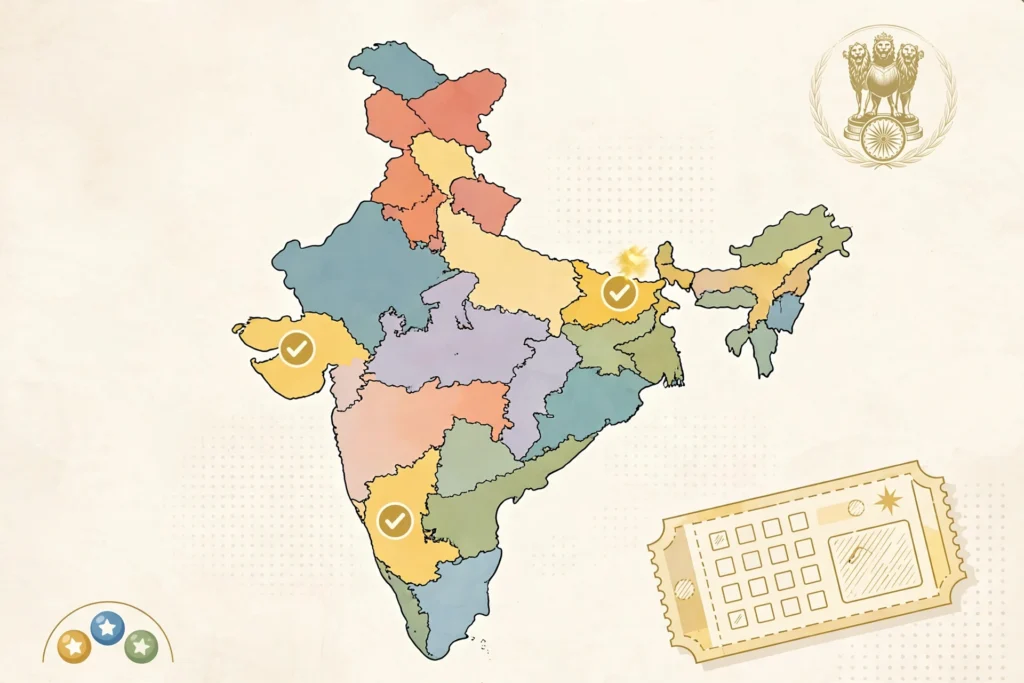
Lottery legality in India is one of the most misunderstood topics in Indian gambling law, because there is no single yes-or-no answer. Lotteries are legal in some states, banned in others, and governed by a central law that leaves the final decision to each state government. If you live in India, or you are visiting and wondering whether you can buy a ticket, the answer depends entirely on where you are standing when you buy it. This guide explains the law in plain language, lists the states on each side of the divide, and clears up the confusion around online tickets and private lotteries. Lottery play in India is strictly for adults aged 18 and over, and all players should play responsibly and only with money they can afford to lose.
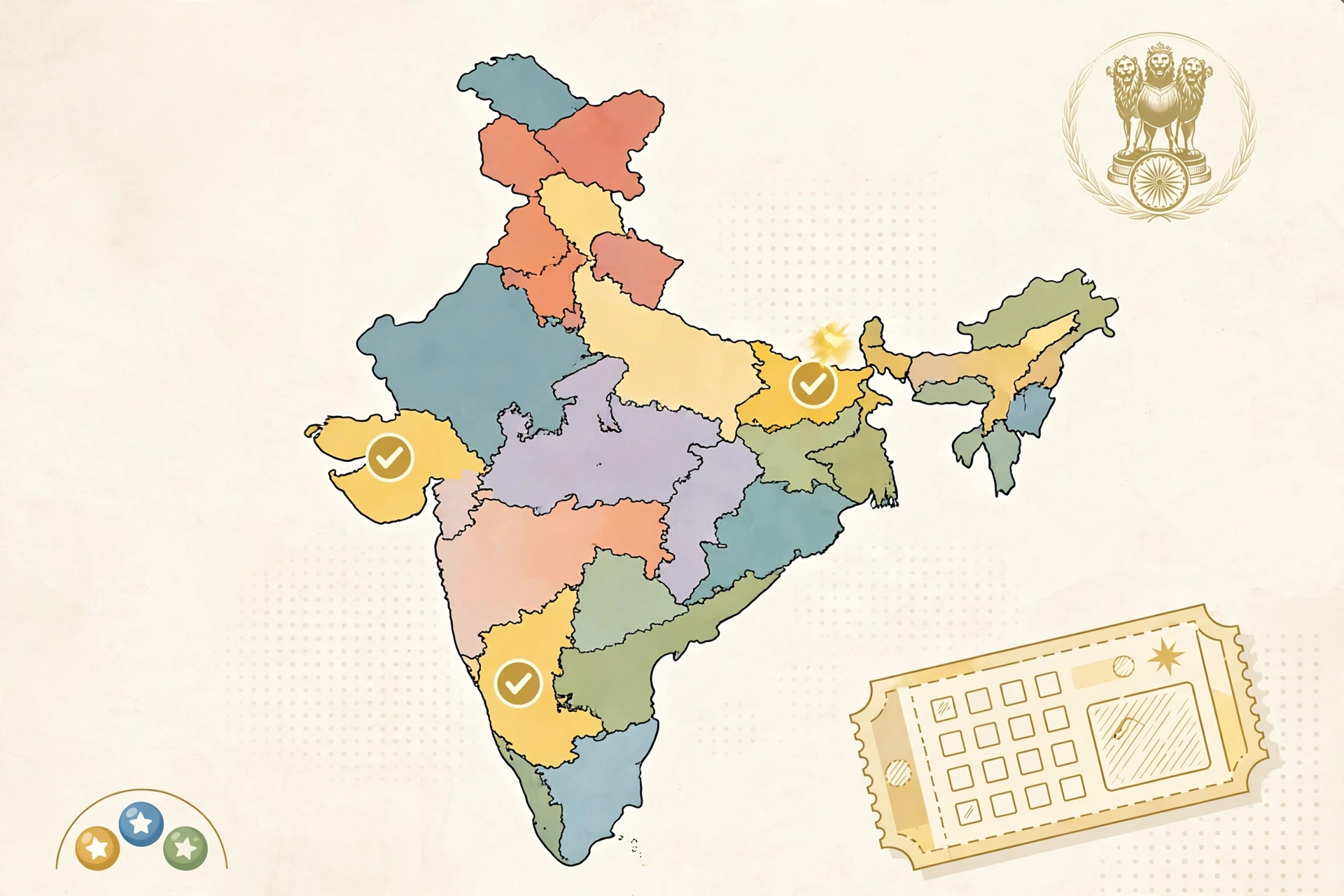
Table of Contents
- The Law: The Lotteries (Regulation) Act, 1998
- States Where Lotteries Are Legal
- States Where Lotteries Are Banned
- The Kerala Model: Why It Gets Mentioned So Often
- Private Lotteries vs State Lotteries
- The Online Grey Area
- What Travellers and Visitors Should Know
- How to Stay on the Right Side of the Law
- Frequently Asked Questions
The Law: The Lotteries (Regulation) Act, 1998
India’s lottery law starts with the Constitution. Lotteries organised by the Government of India or a state government fall under Entry 40 of the Union List, which means Parliament can legislate on them. Parliament did so with the Lotteries (Regulation) Act, 1998, which came into force on 2 October 1997 and received presidential assent in July 1998. The Act’s basic rule is a ban with an exception: no state government may organise, conduct or promote a lottery — except where it follows the conditions laid down in Section 4 of the Act.
Those conditions are strict. Only the state government itself may run the lottery. Tickets must carry the state’s imprint and logo so their authenticity can be checked. The state must conduct the draws itself, inside the state, with no more than one draw per week for a given lottery and no more than six bumper draws in a calendar year. Prizes may not be offered on a pre-announced number or a single digit. Proceeds go into the state’s public account, and unclaimed prize money becomes the property of the state government after the period it prescribes. The Act is supplemented by the Lotteries (Regulation) Rules, 2010, which add detailed procedures for draws and computerised systems. You can read the full text of the Act on Indian Kanoon — The Lotteries (Regulation) Act, 1998.
Crucially, the Act does not force any state to run a lottery. It gives each state a choice: organise a lottery under these rules, or prohibit lotteries altogether. Section 5 adds another twist — a state may prohibit the sale, within its own borders, of tickets from lotteries run by other states. That is why the map of India looks so patchy: a ticket that is perfectly legal in one state can be illegal to sell just across the border. The Supreme Court has upheld states’ power to ban lotteries, holding that selling lottery tickets is not a fundamental right and that lotteries are not ordinary trade.
States Where Lotteries Are Legal
As of recent reporting, around thirteen states permit and regulate government-run lotteries. The commonly cited list is: Kerala, Goa, Maharashtra, Punjab, West Bengal, Madhya Pradesh, Assam, Arunachal Pradesh, Meghalaya, Manipur, Sikkim, Nagaland and Mizoram. State lists do change over time as governments start or stop schemes, so treat any list — including this one — as a snapshot to verify against the state’s own lottery department before you act on it.
Each of these states runs its lottery differently. Kerala’s lottery, launched in 1967, is one of the oldest and best known, with daily draws and seasonal bumper draws. Maharashtra runs a large state lottery with multiple weekly schemes. Nagaland’s Dear lottery and Sikkim’s lotteries are widely sold in the states where they are permitted. Goa, Punjab and West Bengal also operate long-standing state schemes. In every case, the common thread is government control: the state organises the draw, prints or authorises the tickets, and publishes results through its own department. If you want to check whether a particular scheme is genuine, the state’s official lottery department is the place to look, not a random website or social media seller.
States Where Lotteries Are Banned
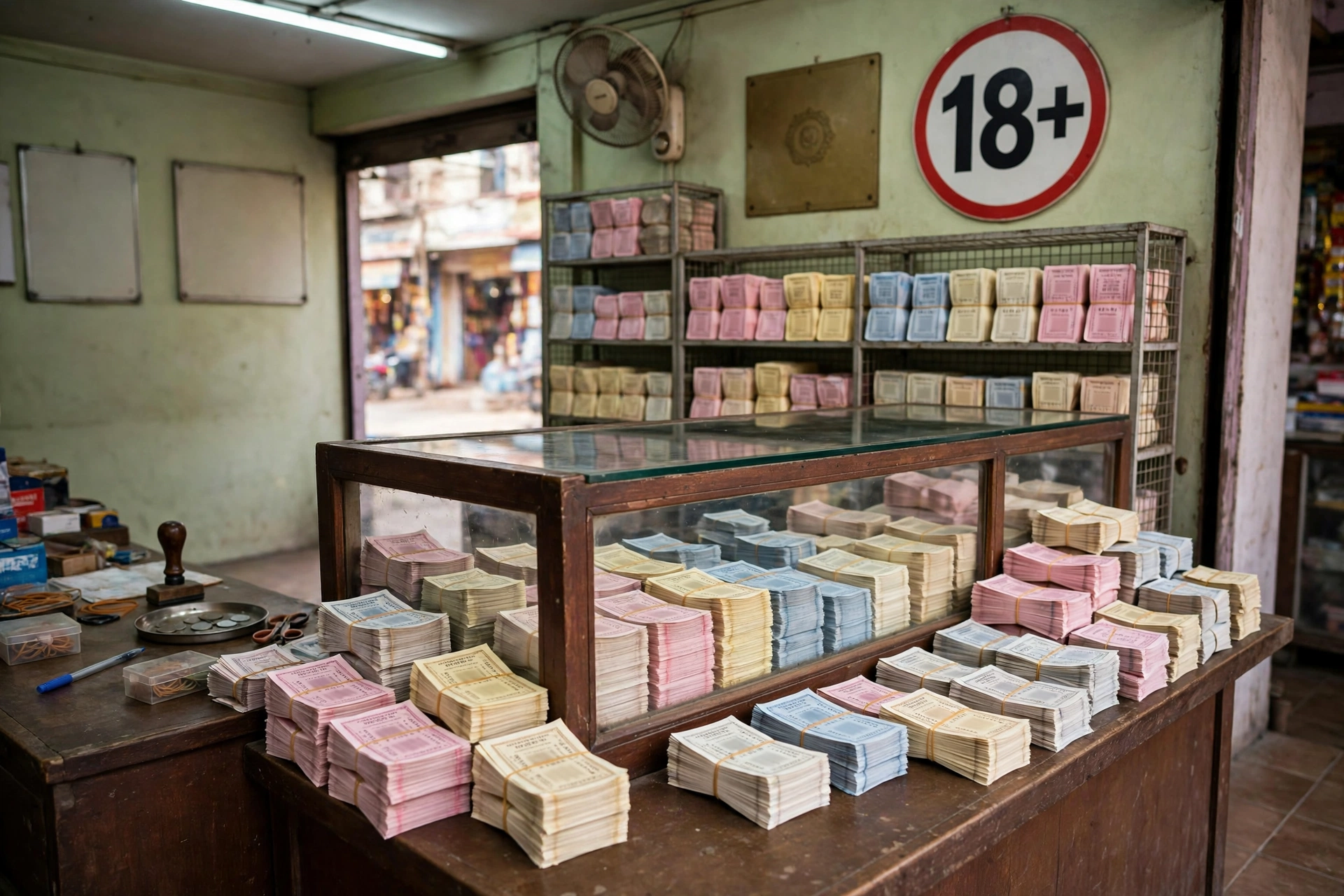
Most other Indian states have chosen to ban lotteries. The best-known examples include Tamil Nadu and Karnataka, both of which were once major lottery centres before banning the trade — Karnataka banned lotteries in 2007 and set up a dedicated enforcement wing. Other states with bans include Gujarat, Uttar Pradesh, Bihar, Delhi (for physical lotteries), Telangana, Andhra Pradesh, Haryana, Rajasthan and Odisha, among others. In a banned state, selling lottery tickets is an offence, and buying from an unauthorised seller carries real legal risk as well as the obvious risk of fraud.
The reasons states give for banning lotteries are consistent: the social cost. State governments that have banned lotteries argue that the revenue is outweighed by gambling harm in low-income households, addiction, and the growth of illegal lottery rackets that flourish alongside or in place of legal ones. States that keep lotteries argue the opposite: that a regulated state lottery raises revenue for public spending, undercuts the illegal market, and gives players a verifiable, audited draw. Both arguments have shaped policy for decades, and neither side has won nationally — which is exactly why the law remains state by state. For background on this debate, see the Indian Express explainer on the state of the lottery in India.
The Kerala Model: Why It Gets Mentioned So Often
Kerala’s lottery is mentioned in almost every discussion of Indian lottery law, and for good reason. It was started in September 1967, making it one of India’s earliest state lotteries, and it was explicitly designed as a welfare measure: ticket revenue funds public programmes, and a portion supports welfare schemes. Kerala permits only its own state lottery within its borders and prohibits the sale of other states’ tickets there, using the Section 5 power described above. Its draws are conducted publicly, results are published by the Kerala lottery department, and prizes are claimed through a documented process involving the original ticket and identity proof.
The Kerala example also shows why “legal in India” is too vague a phrase to be useful. Kerala’s lottery is legal in Kerala. That does not make it legal to sell Kerala tickets in a state that has banned lotteries, and it does not make every ticket sold under Kerala’s name genuine — fake Kerala tickets are a known scam, which is why checking the ticket’s security features and the official result matters. Our guide to lottery scams and fake win notifications explains the red flags to watch for wherever you play.
Private Lotteries vs State Lotteries
One rule admits no exceptions: private lotteries are illegal in India. No individual, company or organisation other than a state government may organise a lottery. That covers WhatsApp lotteries, office raffles run for profit, “lucky draw” schemes that charge for entry and pay cash prizes by chance, and websites that sell entries into their own draws. Some promotional lucky draws run by businesses as genuine free promotions, where no payment is required to enter, sit in a different legal category — but the moment entry requires payment and prizes are awarded purely by chance, it looks like a lottery, and only a state government may run one.
This is also why you should be suspicious of any “private lottery agent” offering tickets online. A genuine state lottery ticket is sold by the state or its authorised distributors and agents, carries the state’s logo, and can be verified against the state’s published results. Anyone selling you a ticket for a lottery that no state runs, or asking you to pay a fee to “release” a prize, is not operating a legal lottery. If you are ever unsure, check the lottery age limits around the world guide for how age and licensing rules differ by jurisdiction, and remember that in India the minimum age for lottery play is 18.
The Online Grey Area
Online lottery sales are the murkiest part of lottery legality in India. The 1998 Act was written before online sales were common, and it does not expressly address them. Sikkim has legislated for online lottery frameworks, and some states permit online sale of their own state lotteries through authorised channels. But many websites that accept Indian players operate from outside India, and their legal status is contested: they are not Indian state lotteries, they are not licensed by any Indian state, and several states have moved to block or prosecute unauthorised online lottery operations.
For players, the practical advice is cautious. Buying from an offshore site does not automatically make the purchase legal in your state, and it creates real problems if you win: claiming a prize from an unlicensed operator, moving winnings across borders, and proving the ticket’s authenticity are all harder than with a state lottery, and scam sites are common. If a site promises guaranteed wins, asks for an advance fee to release a prize, or cannot name the state lottery it claims to sell, walk away. Stick to authorised sellers of state lotteries in states where they are legal, and treat everything else as a risk you do not need to take.
What Travellers and Visitors Should Know
If you travel between Indian states, the lottery law travels with the place, not with you. A resident of a banned state who buys a ticket while visiting a legal state is buying under that state’s rules, and the ticket must be claimed under that state’s claim rules and deadlines. Conversely, carrying tickets back into a banned state to sell them there would breach that state’s prohibition on sale. Tourists from abroad face the same position: you may buy a state lottery ticket in a legal state if you meet the age requirement, but you should keep the ticket safe, note the claim deadline, and understand that claiming may require presenting the original ticket in person or through the state’s prescribed process. Our guide on how to claim lottery winnings covers the general claim process in more detail.
How to Stay on the Right Side of the Law
The safest approach is simple and boring, which is exactly the point. First, check whether your state permits lotteries at all — if it bans them, do not buy, sell or promote tickets there. Second, buy only from authorised sellers of a genuine state lottery, and verify results through the state’s official lottery department. Third, never pay anyone a fee to claim a prize, and never share bank details with someone who contacts you about a win you did not enter. Fourth, keep your ticket safe and note the claim deadline, because unclaimed prize money eventually becomes state property under the Act. And finally, remember that legality is not the same as a good idea: a legal lottery is still gambling, with very long odds, so set a budget and treat it as entertainment.
Watch: India Government Lotteries Explained
Frequently Asked Questions
Is lottery legal in India?
It depends on the state. Lotteries run by state governments are legal in around thirteen states under the Lotteries (Regulation) Act, 1998, and banned in most other states. There is no single national rule that makes lotteries legal or illegal everywhere in India.
Which states allow lotteries in India?
The commonly cited list is Kerala, Goa, Maharashtra, Punjab, West Bengal, Madhya Pradesh, Assam, Arunachal Pradesh, Meghalaya, Manipur, Sikkim, Nagaland and Mizoram. Lists change as state policy changes, so verify with the state’s own lottery department before relying on any list.
Which states have banned lotteries?
Most other states, including Tamil Nadu, Karnataka, Gujarat, Uttar Pradesh, Bihar, Telangana, Andhra Pradesh, Haryana, Rajasthan and Odisha, have banned lotteries. In those states, selling lottery tickets is an offence.
Can a private company run a lottery in India?
No. Only state governments may organise, conduct or promote lotteries under the 1998 Act. Private lotteries, including paid-entry lucky draws run by individuals or companies, are illegal.
Can I buy another state’s lottery ticket in my state?
Only if your state permits the sale of that state’s tickets. Under Section 5 of the Act, a state may prohibit the sale of other states’ lottery tickets within its borders, and several states do exactly that.
Are online lotteries legal in India?
It is a grey area. The 1998 Act predates online sales, a few states have frameworks for online sale of their own lotteries, and many offshore sites operate outside Indian licensing. Buying from an unlicensed site carries legal and fraud risks, so authorised state lottery sellers are the safer route.
What is the minimum age to play the lottery in India?
18. State lotteries restrict play to adults, and players should carry identity proof when buying or claiming.
What happens to unclaimed lottery prize money in India?
Under the 1998 Act, prize money unclaimed within the period prescribed by the state government becomes the property of that state government.
Conclusion
Lottery legality in India comes down to one question: what does your state say? The 1998 Act lets each state choose, and states have chosen differently — around thirteen run legal state lotteries, while most others ban them outright, and private lotteries are illegal everywhere. Before you buy, check your state’s position, buy only from authorised sellers of a genuine state lottery, and keep your ticket safe until the claim deadline passes. Lottery play is for adults aged 18 and over only: play responsibly, set a budget you can afford, treat tickets as entertainment rather than income, and if gambling ever stops being fun, stop and seek help.