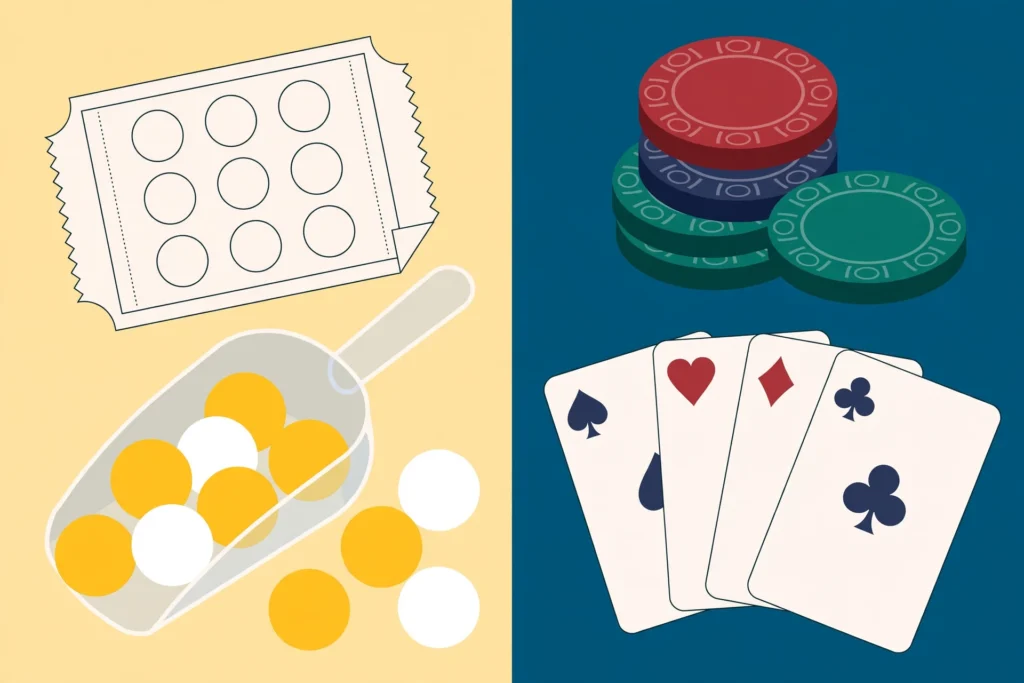
Lottery vs casino games is a comparison people make casually — “it’s all gambling, isn’t it?” — but the differences matter, and they explain why the law, the odds, the cost and the risks are not the same. A lottery is a slow, pure-chance draw with a fixed ticket price. A casino game is fast, repeated play where skill can matter in some games and the house edge is built into every round. Sports betting is something else again: a wager on a real-world event, where knowledge and judgement play a real role and the odds shift with the event itself. This guide compares all three honestly, without pretending any of them is a way to make money. All forms of gambling discussed here are for adults aged 18 and over only, and all players should play responsibly and only with money they can afford to lose.

Table of Contents
- First: They Are All Gambling, Legally Speaking
- How a Lottery Works
- How Casino Games Work
- How Sports Betting Works
- Side-by-Side Comparison
- Skill vs Chance: Where Each One Sits
- Odds, Payouts and the House Edge
- Speed, Cost and Risk
- How the Law Treats Them Differently
- Is Any of Them Safer?
- Frequently Asked Questions
First: They Are All Gambling, Legally Speaking
Under UK law, gambling is an umbrella term covering three categories: gaming (playing a game of chance for a prize, which includes casino games), betting (wagering on the outcome of an event), and participating in a lottery (buying a ticket for a chance-based draw with prizes). The Gambling Act 2005 defines a lottery as an arrangement where prizes are distributed by chance among people who have paid to participate. That shared legal umbrella is why people lump them together — but the Act then regulates each category differently, with different licences, different rules and different protections, because the products behave differently in practice.
The same pattern holds in most regulated markets. Lotteries are often run by state or specially licensed operators and tied to good causes; casinos are licensed venues or platforms with strict rules on games, machines and player protection; sports betting is licensed separately again, with rules on odds, advertising and integrity. Treating them as identical misses the practical differences that affect players most: how fast you can lose money, whether skill helps at all, and what the odds actually look like.
How a Lottery Works
A lottery is the simplest product of the three. You buy a ticket, choose numbers or accept a random selection, and wait for a scheduled draw — usually once or twice a week. Winners are determined entirely by chance, either by balls drawn from a machine or by a certified random number generator, and prizes are paid from the pool of ticket sales after the operator’s costs and, in many countries, a share for good causes. There is no decision to make after buying, no second round, and no way to improve your chances by playing better. Every ticket in a draw has the same chance, and buying more tickets improves your odds only in direct proportion to how many you buy.
That simplicity shapes everything else about lotteries. The ticket price is small and fixed, the wait between buying and knowing the result is days rather than seconds, and the top prizes can be enormous precisely because the odds of winning them are extremely long. Our guide to lottery draw machines: RNG vs ball draws explains how those draws are actually run and audited.
How Casino Games Work
Casino games are a broad family, and they differ from each other almost as much as they differ from lotteries. Slots and roulette are pure chance: each spin is independent, no strategy changes the odds, and the outcome arrives in seconds. Blackjack and poker mix chance with skill: in blackjack, correct basic strategy reduces the house edge, and in poker, skilled players can win consistently against weaker opponents over time, even though any single hand is dominated by luck. Baccarat and craps sit in between, with fixed rules and no meaningful player decisions in some variants.
What casino games share is speed and repetition. A slot player can complete hundreds of spins in an hour, a blackjack player can play dozens of hands, and each round is a fresh chance to win or lose. That repetition is the key difference from a lottery: a lottery ticket gives you one outcome per draw, while a casino session gives you outcome after outcome, which is why losses can accumulate far faster than most players expect. Casino games are also usually played against the house or against other players in real time, in a venue or on a platform designed to keep you playing.
How Sports Betting Works
Sports betting is a wager on the outcome of a real-world event: a match result, a race, a score, or a specific occurrence within a game. The bettor chooses what to bet on, stakes money at odds set by the bookmaker, and wins if the prediction is correct. Unlike a lottery draw, the event exists independently of the bet — the match would happen whether anyone bet on it or not — and the odds reflect the bookmaker’s assessment of probability plus a margin. Knowledge genuinely matters here in a way it does not for lotteries: understanding form, injuries, conditions and markets can improve a bettor’s results, although the bookmaker’s margin means even knowledgeable bettors face an uphill task over time.
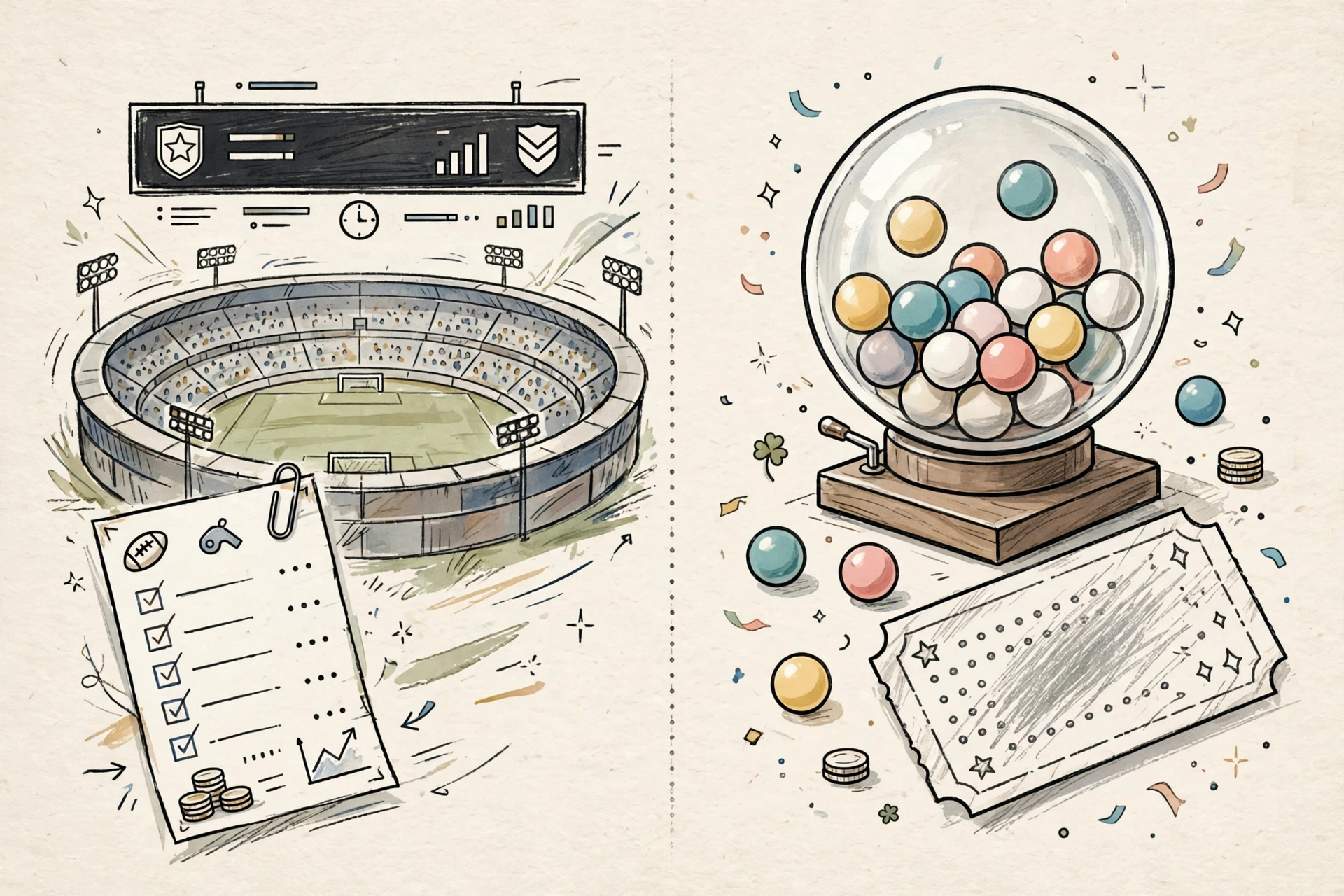
Sports betting also differs in timing and structure. Bets can be placed before an event or live during it, odds move as the event unfolds, and a single event can support dozens of different bets. That flexibility, combined with the feeling of expertise, is part of its appeal — and part of its risk, because it encourages frequent betting and the belief that the next bet is better informed than the last. A useful overview of how these categories are legally separated is available at Online Betting — Is the lottery treated differently to other gambling products?.
Side-by-Side Comparison
| Feature | Lottery | Casino games | Sports betting |
|---|---|---|---|
| What decides the outcome | Pure chance draw | Chance, plus skill in poker/blackjack | Real-world event outcome |
| Speed of result | Days (scheduled draws) | Seconds to minutes, repeated | Minutes to hours, live options |
| Typical cost per play | Small fixed ticket price | Variable stakes, many rounds | Variable stake per bet |
| Can skill improve results? | No | Yes, in some games | Yes, partly |
| Top prize profile | Very large, very unlikely | Moderate, more frequent | Depends on odds and stake |
| Who runs it | State or licensed lottery operator | Licensed casino venue/platform | Licensed bookmaker |
| Good causes share | Often, by law or licence | Tax only, no dedicated share | Tax only, no dedicated share |
Skill vs Chance: Where Each One Sits
Put the three on a spectrum from pure chance to real skill and the order is clear. Lotteries sit at the pure-chance end: nothing you do after buying a ticket changes anything, and no system, lucky number or pattern of past draws improves your odds. Casino games span the middle: slots and roulette are pure chance, while poker and blackjack reward skill over the long run, even though luck dominates any single session. Sports betting sits furthest toward skill, because research and judgement genuinely affect results — but it never becomes a skill-only activity, because the event itself is uncertain and the bookmaker’s margin is built into every price.
That spectrum explains a common misconception. People who would never call themselves gamblers happily buy lottery tickets, because lottery play feels like entering a raffle rather than gambling. People who study sports betting often resist the gambler label too, because their activity feels like applied knowledge. Both are gambling under the law, and both can cause harm. The label matters less than the behaviour: money staked on an uncertain outcome, with the risk of loss, is gambling whatever you call it.
Odds, Payouts and the House Edge
The odds tell the same story from a different angle. Lottery jackpots have famously long odds — often one in tens or hundreds of millions — which is why the prizes can be so large: millions of tickets fund one enormous prize. Smaller lottery prizes have far better odds, but the overall return to players is typically lower than in casino games or sports betting, because a significant share of sales goes to good causes, taxes and operating costs. In other words, lotteries are a poor-value bet with a spectacular top prize.
Casino games work on a house edge: a built-in mathematical advantage, often a few per cent, that guarantees the house wins over time while individual players may win in the short term. A game with a 2% house edge returns about 98% of stakes to players collectively over the long run — far better value per pound than a lottery, but played hundreds of times faster, which is why total losses can still be large. Sports betting works on a margin (the overround): the bookmaker prices all outcomes so the implied probabilities add up to more than 100%, and that excess is the bookmaker’s edge. Skilled bettors can sometimes beat that margin, but most do not over time. None of these structures makes any form of gambling a reliable way to make money, and anyone selling a “system” that claims otherwise is selling a fantasy.
Speed, Cost and Risk
Speed is the single biggest risk difference. A weekly lottery ticket costs a small fixed amount and produces one result per week, so even a regular player spends a predictable, limited sum. A casino session or a live-betting session can produce hundreds of results in an evening, each with its own stake, so spending can escalate far beyond the original plan before the player notices. That is why casino and sports betting products carry higher rates of gambling harm in research, and why their responsible-play tools — deposit limits, session timers, reality checks — matter more urgently there. Lottery play is not risk-free: regular ticket buying adds up, and the dream of a jackpot can distort spending, especially for players on low incomes. But the pace of loss is fundamentally slower.
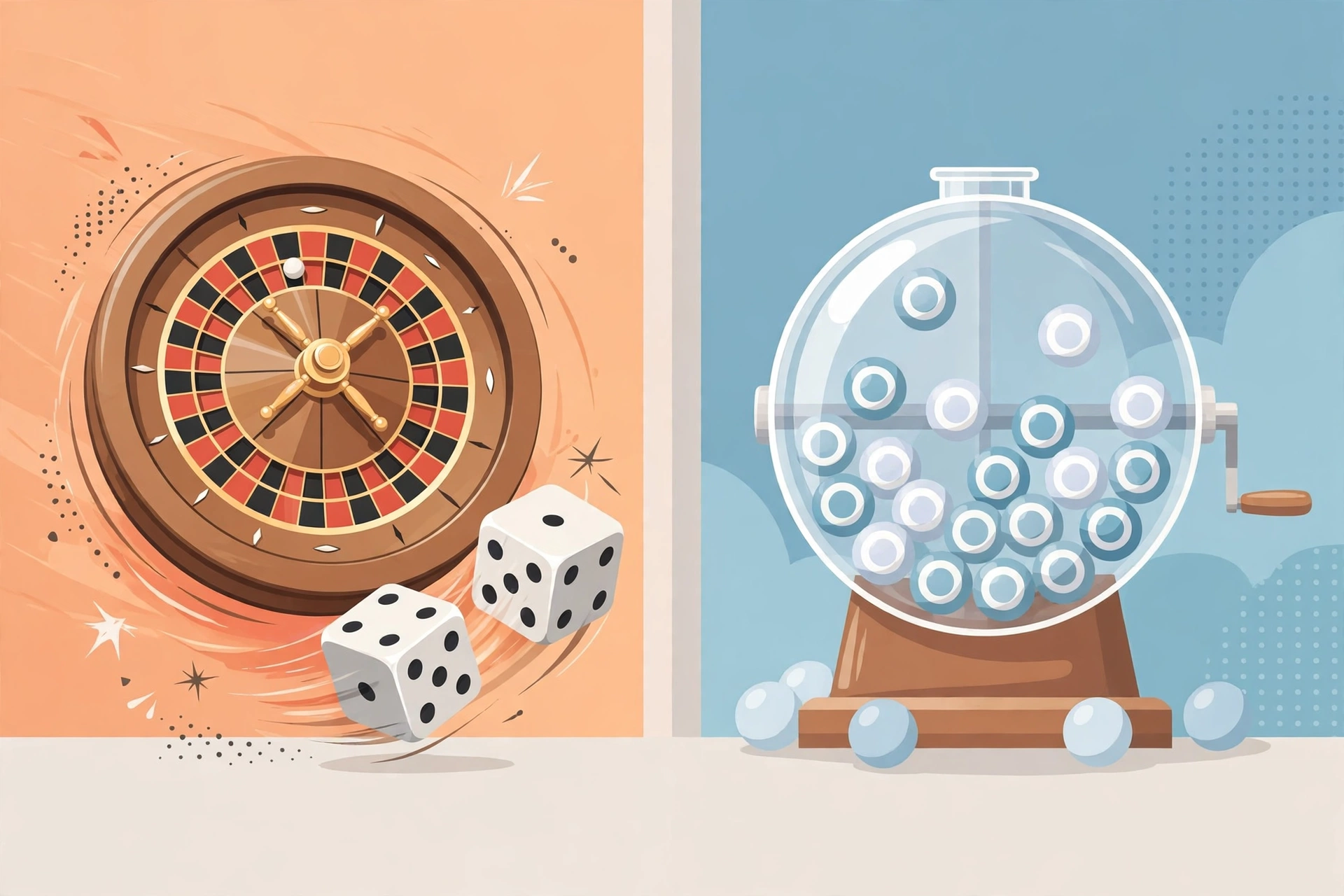
Cost per session follows the same pattern. A lottery player’s weekly spend is visible and bounded; a casino or betting player’s session spend is variable and can spike. That is also why budgeting advice differs: lottery budgeting is about a small weekly cap, while casino and betting budgeting needs session limits, loss limits and time limits as well. For lottery-specific budgeting, see our lottery budgeting guide, and for the wider toolkit, our lottery terms glossary explains the language operators use for all three categories.
How the Law Treats Them Differently
Regulators treat these products differently for good reasons. Lotteries are often state-run or run under a special licence with a good-causes obligation, and their advertising is sometimes permitted to use language — such as highlighting life-changing prizes — that would not be allowed for casino advertising. Casinos face strict rules on game fairness, machine numbers, player protection and, in many places, where venues can be located. Sports betting faces rules on odds transparency, integrity monitoring to detect match-fixing, and restrictions on advertising around live sport. Age limits are broadly 18+ across all three in most regulated markets, but enforcement and licensing details differ by product and jurisdiction.
The differences also show up in where each product is legal. Many jurisdictions that ban casinos still run a state lottery; many that ban sports betting still allow lotteries; and some that allow all three regulate them under entirely separate laws. A good general discussion of the distinctions is available at Business Daily — How lottery, gambling and betting are different. Before playing any of these products, check the law where you are — not the law where the operator is based, and not the law in a country you read about online.
Is Any of Them Safer?
No form of gambling is safe in the sense of being risk-free, but they are not equally risky, and the differences are worth stating plainly. Lottery play, bought occasionally with a small fixed budget, is the lowest-intensity form: slow, bounded, and easy to track. Casino play and sports betting are higher-intensity: faster, easier to repeat, and more likely to produce large losses in a short time, especially when skill illusions or live betting encourage continued play. That does not make lottery play harmless — regular spending adds up, and chasing a jackpot is a real pattern of harm — but it does mean the risk profile is different, and players should choose their limits accordingly.
The honest rule for all three is the same: treat gambling as paid entertainment, never as income; set a budget you can afford to lose completely; never borrow money to play; never chase losses; and stop the moment it stops being fun. If you play lotteries, a weekly cap and a habit of checking tickets promptly is usually enough. If you play casino games or bet on sports, use the operator’s deposit limits, loss limits and session timers as well — and if any form of play starts affecting your money, relationships or peace of mind, use self-exclusion and free support services rather than trying to win your way out.
Watch: Lottery vs Casino Games and Sports Betting
No verified topical YouTube video was found for this subject, so no video is embedded here.
Frequently Asked Questions
Is a lottery a form of gambling?
Yes. Under laws such as the UK Gambling Act 2005, participating in a lottery is one of the three legal categories of gambling, alongside gaming (casino games) and betting.
What is the main difference between lottery and casino games?
Speed and repetition. A lottery gives one slow, pure-chance result per draw at a small fixed price, while casino games give fast, repeated results, sometimes with a skill element, and losses can accumulate much faster.
Does skill help in sports betting?
Partly. Knowledge of form, injuries and markets can improve sports betting results, unlike lotteries where skill plays no role — but the bookmaker’s margin means most bettors still lose over time, and no amount of skill removes the uncertainty of the event.
Which has better odds: lottery, casino or sports betting?
Per pound staked, casino games and sports betting usually return a higher share to players collectively than lotteries, because lotteries divert a large share to good causes and costs. But lottery jackpots are far larger, and casino and betting play is much faster, so “better odds” does not mean safer or more profitable.
Why do lotteries fund good causes but casinos do not?
Many state and national lotteries are licensed on condition that a share of revenue funds good causes such as culture, sport and heritage. Casinos and bookmakers pay tax instead, which governments spend as they choose, with no dedicated good-causes share.
Can I play the lottery if casinos are banned where I live?
Possibly — many jurisdictions ban casinos but run a state lottery, and vice versa. The legality of each product is separate, so check the law for the specific product where you are.
Is lottery play less addictive than casino play?
Research generally finds lower rates of gambling harm for lottery-only players than for casino or sports betting players, largely because of the slower pace — but lottery play can still become harmful, especially when spending is regular and unaffordable.
What is the safest way to play any of these?
Set a strict budget you can afford to lose, use the operator’s limits and timers, never borrow money or chase losses, and stop if play stops being fun. If you need help, use self-exclusion and free support services.
Conclusion
Lottery vs casino games and sports betting is not a contest with a winner — it is a choice between very different products. Lotteries are slow, pure-chance, small-stake draws with enormous but extremely unlikely top prizes. Casino games are fast, repeated play where skill matters in some games and the house edge grinds away over time. Sports betting is a wager on real events where knowledge helps but the bookmaker’s margin and the event’s uncertainty still rule. Knowing those differences helps you set sensible limits, avoid false beliefs about skill or systems, and recognise when play is becoming a problem. All gambling is for adults aged 18 and over only: play responsibly, keep every form of play inside a budget you can afford to lose, treat it as entertainment rather than income, and if it ever stops being fun, stop and seek help.