
Ever wondered what stops someone from simply photocopying a winning ticket? The answer lies in the lottery ticket security features built into almost every ticket you buy. From invisible inks to encrypted validation numbers, a modern lottery ticket is closer to a banknote than to an ordinary receipt. Understanding these features will help you spot a genuine ticket, protect your own ticket, and understand why claims are checked so carefully. As always, lottery play is for adults only — you must be 18 or over to play, and you should always play responsibly and within a budget you can afford.

Table of Contents
- Why Lottery Tickets Need Security
- Barcodes and QR Codes: The Ticket’s Fingerprint
- Validation Numbers and Serial Numbers
- Special Inks: UV, Colour-Shifting and Thermochromic Ink
- Holograms and Foils
- Security Paper, Watermarks and Microprint
- Tamper-Evident Features on Scratch Cards
- How Ticket Validation Actually Works
- How to Protect Your Own Ticket
- Frequently Asked Questions
Why Lottery Tickets Need Security
A lottery ticket is a bearer-style document: in many places, whoever holds a valid winning ticket can claim the prize. That makes tickets an obvious target for counterfeiting, alteration and theft. Operators therefore layer many defences together, so that defeating one feature still leaves several others standing. The goal is not to make a ticket impossible to copy in theory, but to make a fake so hard and so expensive to produce — and so easy for a retailer or lottery office to detect — that fraud is not worth attempting. This layered approach is the same idea used for banknotes and passports, and it is one reason official lotteries can be trusted to pay genuine winners.
It is worth noting that security features vary by operator and by game. A draw-game ticket printed at a shop terminal and a pre-printed scratch card are made in different ways and carry different features. What they share is a unique identity in the operator’s central system: the paper ticket is only half the story, and the record held by the lottery is the other half.
Barcodes and QR Codes: The Ticket’s Fingerprint
Almost every modern ticket carries a barcode, and many now carry a QR code as well. Each code is unique to that ticket and typically encodes the game, the draw date, the numbers played and a reference to the ticket’s record in the central system. When a retailer scans your ticket, the terminal does not simply read the numbers printed on the front — it asks the central system whether that exact ticket exists, whether it has already been claimed, and what prize, if any, it is owed.
This is why a photocopy of a winning ticket is useless: the copy may look identical, but the system will show that the original has already been paid, or that the copied code does not match an unclaimed record. QR codes add extra capacity, allowing more data to be stored and checked, and some operators use codes that link to an official results or ticket-checking page. Never share a clear photo of your ticket’s barcode online — anyone with that image could try to claim before you do.

Validation Numbers and Serial Numbers
Alongside the barcode, tickets carry serial numbers — typically a game number, a pack or book number and an individual ticket number. On scratch cards, there is also a validation number, often printed under the scratch-off coating or on the back of the card. This number is usually encrypted or algorithmically linked to the card’s prize outcome, so the operator can confirm that the symbols revealed on the card match the prize the system expects for that exact card.
If someone alters a scratch card — for example, by scratching, changing a symbol and re-covering it — the validation number will no longer match, and the claim will be refused. Retailers and lottery offices also use these numbers to trace a ticket back through distribution: which terminal or shop sold it, and when. That audit trail is a powerful deterrent, because a fake ticket has no genuine distribution history.
Special Inks: UV, Colour-Shifting and Thermochromic Ink
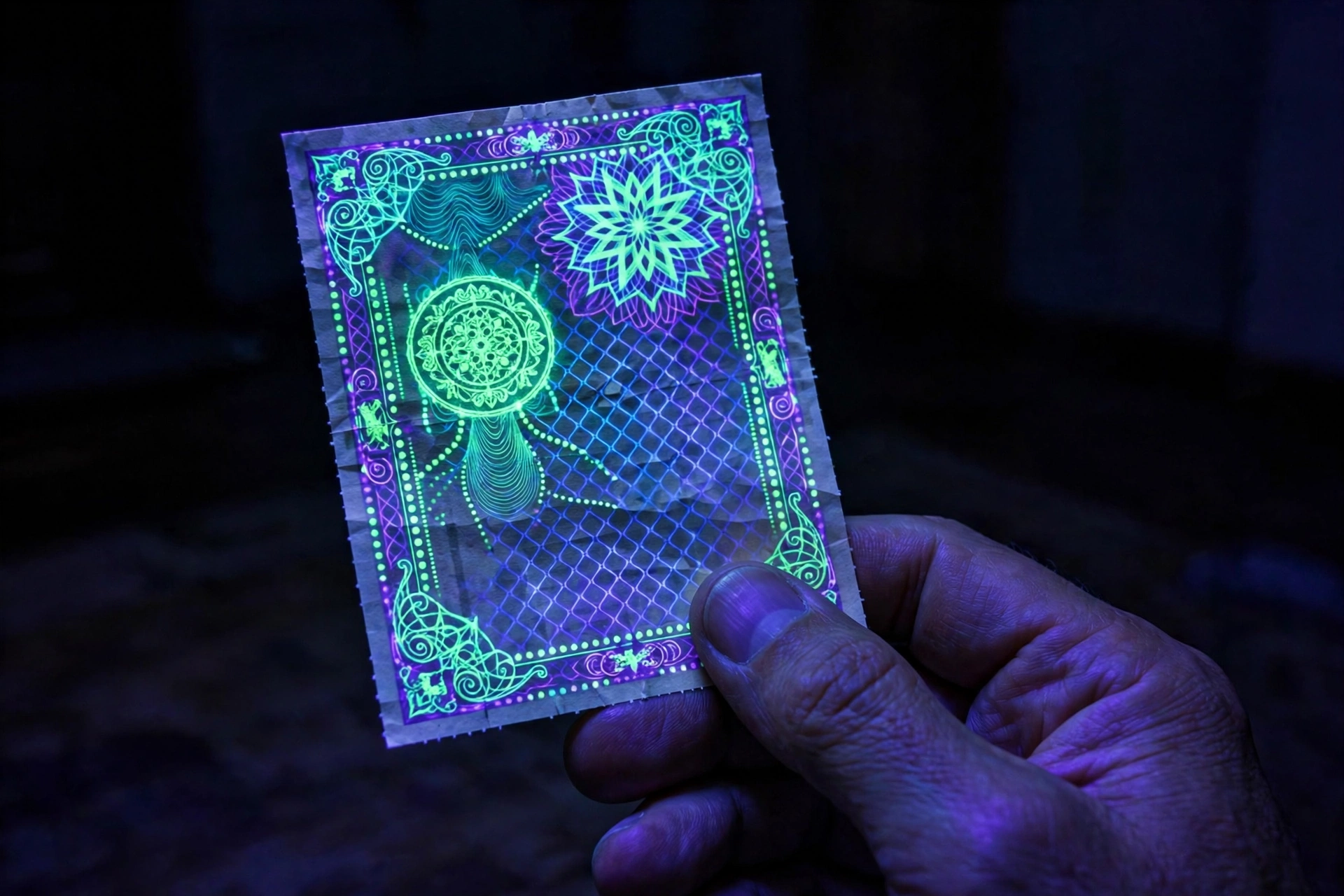
Some of the most interesting lottery ticket security features are invisible in normal light. Ultraviolet (UV) inks only appear under a UV lamp, revealing hidden patterns, logos or codes that a standard printer cannot reproduce. Infrared inks behave similarly under specialist readers. Colour-shifting inks change colour when you tilt the ticket, and thermochromic inks react to warmth — a feature sometimes used on scratch cards, where rubbing the panel with a finger briefly changes its appearance.
These inks matter because they defeat the most common attack: a colour photocopy or a home-printer copy. A copier can reproduce what it can see, but it cannot reproduce ink that only shows up under UV light or that shifts colour with angle. Lottery staff and many retailers have simple tools — a UV lamp or a magnifier — that make these checks quick and routine.
Holograms and Foils
Holograms are one of the most recognisable security features, and some jurisdictions apply them to lottery tickets just as they are applied to banknotes and ID cards. A hologram is a three-dimensional-looking image formed by microscopic patterns that bend light; tilt the ticket and the image shifts, sparkles or changes. Genuine holograms are produced with specialist equipment that is far beyond a home printer, and a photocopied hologram simply goes flat and dull.
Metallic foils work on a similar principle. A foil strip or patch adds a reflective, patterned element that is difficult to fake convincingly and easy for staff to check at a glance. Not every ticket uses holograms — they add cost — but where they appear, they are a strong, visible sign of authenticity.
Security Paper, Watermarks and Microprint
The paper itself is part of the defence. Security paper may include a watermark — a faint pattern or word formed during papermaking that is visible when the ticket is held up to light. Because the watermark is part of the paper rather than printed on top of it, it cannot be added by a copier. Some tickets also use security threads, thin strips embedded in the paper, similar to those in banknotes.
Microprint is another quiet workhorse: extremely small text, readable only under magnification, printed along borders or inside patterns. On a genuine ticket the microprint is crisp; on a copy it blurs into an unreadable line. Related tricks include “void screens” — patterns that look normal to the eye but reveal a word such as VOID when photocopied. Together, these printing techniques mean that even a high-quality copy betrays itself under close inspection.
Tamper-Evident Features on Scratch Cards
Scratch cards face a special threat: someone might try to read the hidden prize area without scratching, or alter it afterwards. Manufacturers counter this with latex scratch coatings that show clear signs of disturbance, special adhesives that leave a visible mark if a covering layer is lifted, and intricate background patterns that break up if tampered with. Some cards also use a two-layer design, where the prize symbols sit beneath a coating that cannot be re-applied invisibly once removed.
For players, the practical lesson is simple: buy scratch cards from authorised retailers, check that the scratch area looks untouched, and do not buy a card whose coating looks disturbed, re-glued or oddly shiny. If a card looks tampered with, ask the retailer about it before you pay.
How Ticket Validation Actually Works
When you hand a ticket to a retailer or a lottery office, several checks happen in seconds. First, the barcode or QR code is scanned and matched against the central system. Second, the ticket’s serial and validation numbers are compared with the expected record. Third, staff may check visible and invisible features — hologram, UV pattern, paper quality — especially for larger prizes. For big wins, the ticket may be sent for deeper forensic examination, and the claim may take longer while the operator verifies every layer.
This is also why there are claim deadlines and why unclaimed lottery prizes eventually expire: the system tracks every ticket from sale to claim, and a prize that is never validated simply remains unclaimed. Understanding how lottery draws are conducted and kept fair completes the picture — secure tickets and secure draws are two halves of the same trust system.
How to Protect Your Own Ticket
Security features protect the lottery, but you should protect your ticket too. Sign the back of your ticket where a signature panel is provided, as soon as you buy it — this helps prove ownership if it is lost or stolen. Keep it somewhere safe, dry and away from heat, which can damage thermal-printed tickets. Photograph the front and back for your own records, but keep those photos private and never post the barcode online. Check your ticket promptly through an official retailer terminal or the operator’s official checking channel, and if you think you have won a large prize, contact the operator directly rather than discussing it publicly.
Finally, remember the golden rule that underpins all of this: a ticket is only as safe as the place you bought it. Stick to authorised retailers and official channels, and be wary of anyone offering tickets at a discount or through unofficial routes. If a deal looks too good to be true, it almost certainly is — see our guide to lottery myths debunked for more common traps.
Watch: How Lottery Tickets Are Protected
No verified topical video was found for this subject, so no video is embedded here. The sections above cover the key features in full.
Frequently Asked Questions
Can a lottery ticket be counterfeited?
In practice, a convincing fake is extremely difficult. A counterfeiter would need to reproduce the barcode, validation number, security paper, inks and holograms — and, crucially, create a matching record in the operator’s central system, which a printed copy cannot do. Claims are checked against that system, so fakes are caught at validation.
What should I do if my ticket looks damaged?
Take it to the retailer or contact the lottery operator. Minor wear is usually fine as long as the barcode and serial numbers are readable, but heat-damaged, torn or washed tickets may need special handling. Do not try to repair a ticket yourself with tape or ink, as that can look like tampering.
Why do retailers scan tickets instead of just reading the numbers?
Scanning checks the ticket against the central system, confirming it is genuine, unclaimed and entitled to the prize shown. Reading the printed numbers alone could not prove any of that.
Is the barcode the same as the validation number?
No. The barcode is a machine-readable version of the ticket’s identity, while the validation number is a separate code — often hidden under a scratch coating — that links the ticket to its prize outcome. Both are checked during validation.
Can UV light really reveal fake tickets?
Yes, as one check among many. Genuine UV inks produce specific patterns under a UV lamp that standard printers cannot reproduce. Retailers and lottery offices use UV lamps alongside barcode and serial-number checks.
Should I sign my lottery ticket?
Yes, where a signature panel is provided. Signing the back immediately after purchase helps establish ownership and can help if the ticket is lost or disputed. Check your operator’s rules, as some require a signature before a large prize can be claimed.
Conclusion
Lottery ticket security features — barcodes, validation numbers, UV and colour-shifting inks, holograms, watermarks, microprint and tamper-evident coatings — work together as a layered defence, backed by a central computer system that knows every genuine ticket. You do not need to memorise every feature, but knowing they exist helps you buy safely, spot suspicious tickets and look after your own. Keep your ticket safe, sign it, check it through official channels, and never share its barcode publicly. And remember: lottery games are for adults aged 18 and over only — play responsibly, set a budget, and treat the lottery as entertainment, never as a way to make money.
Pingback: Lottery Syndicates Explained: How They Work, and Whether Joining One Is Worth It - winerlotto.com