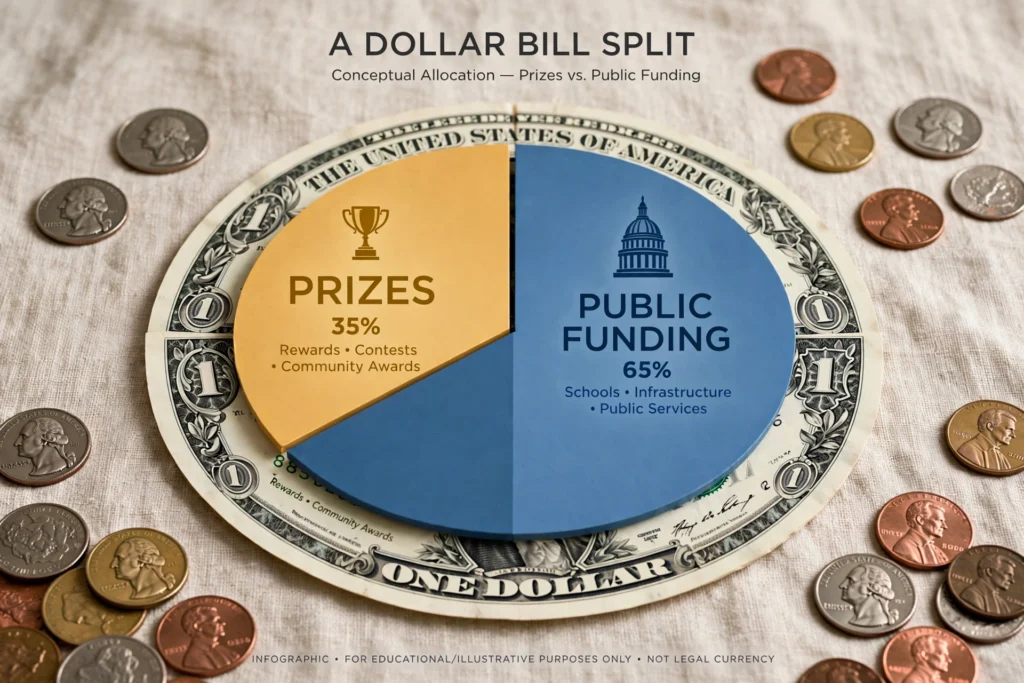
How lottery revenue funds public programs is one of the most common questions about lotteries, and the answer is more structured than most people expect. When you buy a lottery ticket, the money does not go to a single place. It is split between prizes, administration, retailer commissions, and public funding. The public share is the part that supports schools, scholarships, parks, veterans services, and other programs. This guide explains where each ticket dollar goes, which programs benefit, and what the limits of lottery funding really are. Remember: only adults aged 18 or older may play the lottery in most jurisdictions, so play responsibly and treat any lottery game as entertainment, not as a way to make money.
Table of Contents
- Where Does a Lottery Dollar Go?
- Education: The Largest Beneficiary in Many States
- Scholarships and Higher Education
- Parks, Recreation, and Veterans Services
- Health, Seniors, and Other Public Programs
- How Lottery Funding Is Reported
- What Lottery Funding Cannot Do
- Examples From the United States and Abroad
- Frequently Asked Questions
- Video: Watch and Learn
- Conclusion
Where Does a Lottery Dollar Go?
Every lottery publishes a slightly different split, but the pattern is similar across most state and national lotteries. A large share goes back to players as prizes. A smaller share covers the cost of running the lottery, including staff, technology, advertising, and retailer commissions. The remainder goes to public programs.
- Prizes: Usually 50 to 65 percent of ticket sales, depending on the game.
- Administration and operations: Usually 5 to 10 percent.
- Retailer commissions: Usually 5 to 7 percent, paid to the shops that sell tickets.
- Public funding: Usually 25 to 35 percent, transferred to education or other designated programs.
These percentages are illustrative, not exact for every lottery. Some games return more to players, while others return more to public programs. The key point is that lottery revenue is not pure profit for the government. Most of the money is returned as prizes or spent on running the games.
For a clearer picture of how lotteries use their revenue for good causes, see our guide to charity lotteries, which explains how some lotteries are designed specifically to raise money for charitable purposes.
Education: The Largest Beneficiary in Many States
In many U.S. states, education is the main beneficiary of lottery revenue. The money may go to K-12 schools, to school construction, to teacher salaries, or to a general education fund. The exact use depends on the law that created the lottery in that state.

For example, the North Carolina Education Lottery publishes regular reports on how much money has gone to education and how it has been used. In other states, lottery revenue supports school building programs, classroom technology, or early childhood education.
It is important to understand that lottery money usually supplements education funding, rather than replacing it. Schools still receive most of their funding from taxes and other sources. Lottery revenue is an additional source, not the main one.
Scholarships and Higher Education
Some lotteries direct a large share of their public funding to scholarships and higher education. In these states, students can apply for lottery-funded scholarships that help pay for college tuition, fees, or books.

Georgia’s HOPE Scholarship, funded in part by lottery revenue, is one of the best-known examples. Tennessee, Florida, and other states have similar programs that use lottery money to support college students. These programs often have academic requirements, such as a minimum grade point average, and they may cover only part of the cost of college.
Scholarship programs funded by lotteries are popular, because they give a visible, positive use for lottery revenue. They also show how lottery funding can be targeted to a specific group, rather than going into a general government budget.
Parks, Recreation, and Veterans Services
Not all lottery revenue goes to education. In some states and countries, it supports parks, recreation, environmental protection, or veterans services.

For example, some lotteries fund state parks, trails, and wildlife conservation. Others support services for veterans, including housing, health care, and employment programs. These uses are often written into the law that created the lottery, so the money cannot easily be redirected to other purposes.
This variety shows that “public programs” does not mean only schools. It can mean any program that a government has chosen to fund with lottery revenue, as long as that choice is set out in law.
Health, Seniors, and Other Public Programs
In some jurisdictions, lottery revenue also supports health programs, services for seniors, or programs for people with disabilities. For example, Pennsylvania’s lottery supports programs for older adults, including transportation, meals, and prescription assistance.
Other lotteries support public health campaigns, addiction services, or community health programs. These uses are less common than education funding, but they show how flexible lottery revenue can be when it is directed by law.
When a lottery supports multiple programs, its annual report usually breaks down how much went to each program. That breakdown helps the public see whether the money is being used as promised.
How Lottery Funding Is Reported
Most lotteries publish annual reports, financial statements, or online dashboards showing how much revenue was raised and where it went. These reports are usually audited, and they are often reviewed by state auditors or legislative committees.
Transparency matters, because lottery revenue is public money once it is transferred to a government program. Players and taxpayers should be able to see how much was raised, how much was paid in prizes, and how much reached public programs.
If you want to check a specific lottery, look for its annual report on the official lottery website. The report should show ticket sales, prize payouts, operating costs, and transfers to public programs for that year.
What Lottery Funding Cannot Do
Lottery revenue is often presented as a solution to funding problems, but it has clear limits. Understanding those limits helps avoid unrealistic expectations.
- It is not stable: Lottery sales rise and fall with jackpots, the economy, and public interest. A year with a large jackpot may raise more money, while a quiet year may raise less.
- It is not large enough to replace taxes: Even in states with large lotteries, lottery revenue is usually a small share of total education or government spending.
- It can be regressive: Research shows that lower-income players often spend a larger share of their income on lottery tickets. That raises questions about fairness, even when the money funds public programs.
- It can be diverted: In some cases, governments have used lottery revenue to replace other funding, rather than to add to it. That means schools may not receive as much additional money as players expect.
These limits do not mean lottery funding is unimportant. They mean it should be seen as one source among many, not as a complete solution for education or other public needs.
Examples From the United States and Abroad
In the United States, lottery funding varies by state. Some states direct almost all public lottery revenue to education. Others split it between education, parks, veterans, and other programs. A few states direct lottery revenue to the general fund, where it can be used for any government purpose.
Florida’s lottery funding for education is reviewed by independent government reviewers, who check whether the money is being used as intended. Similar reviews exist in other states, and they are an important part of accountability.
Outside the United States, the pattern is similar. In the United Kingdom, National Lottery revenue supports arts, sports, heritage, and community projects through the Good Causes fund. In India, state-run lotteries are legal only in certain states, and the revenue is used according to state law. In many European countries, lotteries support culture, sports, and social programs.
These examples show that lottery funding is a global practice, but the specific programs it supports depend on local law and public priorities.
Frequently Asked Questions
How much of a lottery ticket goes to public programs?
It varies by lottery, but a typical range is 25 to 35 percent of ticket sales. The rest goes to prizes, administration, and retailer commissions.
Does lottery money really go to schools?
In many states, yes. Lottery revenue is transferred to education funds, but it usually supplements other education funding rather than replacing it.
Can lottery revenue be used for any purpose?
It depends on the law that created the lottery. Some lotteries must direct revenue to specific programs, while others transfer it to the general fund.
Is lottery funding a reliable source of revenue?
Not entirely. Lottery sales can vary from year to year, so governments should not rely on lottery revenue alone to fund essential services.
Where can I check how my state’s lottery uses its revenue?
Look for the annual report on the official lottery website. It should show ticket sales, prize payouts, operating costs, and transfers to public programs.
Video: Watch and Learn
Watch this short video to see how lottery revenue is divided and why it matters for public programs.
Conclusion
Lottery revenue funds public programs in a structured, transparent way, but it is only one part of public funding. Most of each ticket dollar goes back to players as prizes, with the remainder split between running the lottery and supporting schools, scholarships, parks, veterans services, and other programs.
If you play, do so only if you are 18 or older where required, play responsibly, and remember that the lottery is entertainment, not a financial plan. The public benefits of lotteries are real, but they do not make playing a good way to make money.