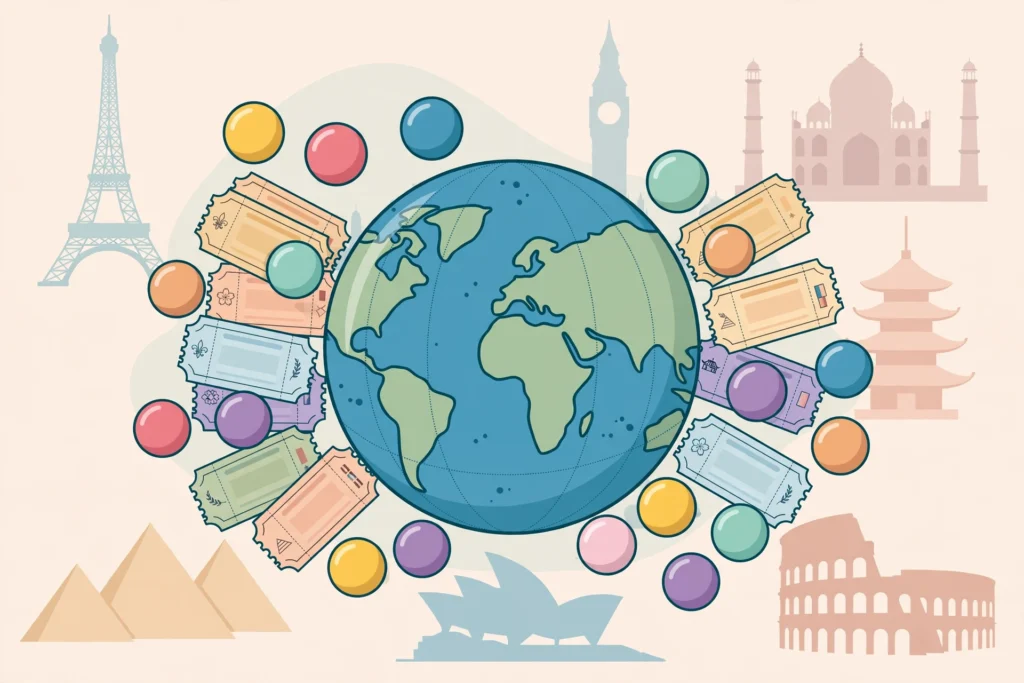
Almost every country has a lottery, but no two games are quite the same. Some chase billion-dollar jackpots, others spread billions across thousands of winners, and some are woven into national holidays. This guide has lottery games around the world explained in one place, comparing the biggest and most interesting formats, their odds, and their prize styles, so you can understand what makes each game different. One important note before we start: this is a general guide to published game rules only. Lottery availability, prices, and rules vary by country, and you should always check the official operator in the country where a ticket is sold. And as with every post on this site: you must be 18 or older to play, and lotteries should always be played responsibly, as entertainment only.
Table of Contents
- Why Lotteries Differ So Much From Country to Country
- United States: Powerball and Mega Millions
- Europe: EuroMillions and Eurojackpot
- Spain: El Gordo, the Christmas Lottery
- United Kingdom: Lotto and the National Lottery
- Australia and Other Notable Games
- Comparing the World’s Biggest Lotteries
- How Prizes Are Paid: Lump Sum vs Annuity
- What All These Games Have in Common
- Video: Why You Will (Almost) Never Win
- Frequently Asked Questions
- Conclusion
Why Lotteries Differ So Much From Country to Country
Lotteries are shaped by their history, their laws, and their purpose. In many countries, lotteries were created to raise money for public causes — arts, sport, heritage, or charity — and that purpose still shapes how they are run. Some governments run lotteries directly, others license private operators under strict regulation, and some countries restrict lotteries to individual states or regions. These differences explain why ticket prices, draw schedules, prize structures, and even whether winners’ names are published all vary so widely. The format of the game itself also matters: a game that draws from a larger number pool produces longer odds and bigger rollovers, while a game with a smaller pool produces more frequent, smaller wins.
United States: Powerball and Mega Millions
The United States is home to the two largest jackpot games in the world. Powerball is played across 45 states plus Washington D.C., Puerto Rico, and the U.S. Virgin Islands. Players pick five numbers from 1 to 69 and one Powerball number from 1 to 26, with draws every Monday, Wednesday, and Saturday. The jackpot starts at 20 million dollars and rolls over until it is won, which is how it has reached headline figures above 2 billion dollars. The jackpot odds are 1 in 292,201,338, according to Powerball’s official information. Mega Millions is similar in structure — five numbers from 1 to 70 plus one Mega Ball from 1 to 25, drawn on Tuesdays and Fridays — and it too has produced jackpots above 1.5 billion dollars. Both games offer winners a choice between a lump sum and an annuity paid over 30 years, and both add a multiplier option that can increase non-jackpot prizes. If odds maths interests you, our beginner’s guide to lottery odds explains how those enormous odds figures are calculated.

Europe: EuroMillions and Eurojackpot
Europe’s two big transnational games both use the same 5-from-50 plus 2-from-12 format, but they are separate games with different countries and prize caps. EuroMillions, launched in 2004, is played in nine countries including the UK, France, Spain, and Ireland, with draws on Tuesdays and Fridays. Its jackpot starts at 17 million euros and can climb to a cap of 250 million euros, with 13 prize tiers. Eurojackpot, launched in 2012, is played in 19 European countries, also draws on Tuesdays and Fridays, starts at 10 million euros, and caps at 120 million euros, with 12 prize tiers. Both games pay prizes as one-time lump sums rather than annuities, and both are run by the national operators of their participating countries rather than a single company. The shared-pool model is what lets both games offer jackpots far larger than any single country’s game could sustain alone. For more on how those jackpots grow when nobody wins, see our guide to lottery jackpot rollovers.
Spain: El Gordo, the Christmas Lottery
Spain’s El Gordo de Navidad — “the Fat One” — is unlike any other major lottery. It has been drawn on December 22nd since 1812, making it one of the oldest lotteries in the world, and it is a national cultural event, with the draw broadcast live and watched by millions. Instead of picking numbers, players buy tickets with pre-printed five-digit numbers, and tickets are commonly split into tenths called décimos, so friends, families, and even whole villages often share the same number. The total prize pool regularly exceeds 2 billion euros, but it is spread across thousands of prizes rather than concentrated in one jackpot: the top prize is shared among everyone holding that number. The odds of holding the top number are about 1 in 100,000 — far better than a typical jackpot game — but the top prize per décimo is correspondingly smaller. El Gordo shows that a lottery does not need a single giant jackpot to capture a country’s imagination.
United Kingdom: Lotto and the National Lottery
The UK National Lottery’s flagship game, Lotto, draws on Wednesdays and Saturdays. Players pick six numbers from 1 to 59, and the jackpot rolls over when nobody matches all six. Alongside the main draw, UK players also know EuroMillions, which is sold in the UK with an automatic entry into the UK Millionaire Maker raffle. UK lottery prizes are paid as tax-free lump sums, and the National Lottery directs a share of revenue to good causes across arts, sport, heritage, and community projects — a model that many other national lotteries follow. Claim rules in the UK give winners 180 days from the draw, and prizes above 50,000 pounds must be claimed in person.

Australia and Other Notable Games
Australia runs several large games, including Oz Lotto and Powerball Australia, which follow the familiar pattern of a main number pool plus a bonus pool and produce jackpots in the tens of millions of Australian dollars. Elsewhere, Italy’s SuperEnalotto is famous for very long rollovers, because its jackpot requires matching six numbers from 1 to 90 with no cap, which has produced some of Europe’s largest single-country jackpots. In Asia, lotteries are organised very differently from country to country: some countries run large state lotteries, others restrict or prohibit them, and prize structures range from fixed-amount draws to raffle-style games. In India, lotteries are a state subject, with only some states running government lotteries under strict rules — a topic we cover in our guide to lottery legality in India. The variety is the point: there is no single “world lottery” format, only local games shaped by local law and culture.
Comparing the World’s Biggest Lotteries
| Game | Region | Format | Jackpot start | Jackpot cap | Jackpot odds |
|---|---|---|---|---|---|
| Powerball | USA | 5/69 + 1/26 | $20 million | None | 1 in 292,201,338 |
| Mega Millions | USA | 5/70 + 1/25 | $20 million | None | About 1 in 302 million |
| EuroMillions | Europe (9 countries) | 5/50 + 2/12 | €17 million | €250 million | 1 in 139,838,160 |
| Eurojackpot | Europe (19 countries) | 5/50 + 2/12 | €10 million | €120 million | 1 in 139,838,160 |
| El Gordo | Spain | Pre-printed numbers | Shared top prize | Total pool over €2 billion | About 1 in 100,000 for the top number |
| UK Lotto | UK | 6/59 | Rolls over from a set starting jackpot | No fixed cap | About 1 in 45 million |
Figures are approximate and based on each game’s published rules; jackpots, caps, and formats can change, so always check the official operator for the current position.
How Prizes Are Paid: Lump Sum vs Annuity
One of the biggest differences between the world’s lotteries is how winners actually receive the money. American jackpot games typically offer a choice: a single cash lump sum, or an annuity of 30 graduated payments over 29 years. European games and the UK National Lottery pay lump sums. El Gordo pays its prizes as lump sums shared among the holders of each winning number. And some games, such as certain “for life” prizes, pay a fixed annual amount instead. These payment styles change the real value of a headline prize dramatically, which is why comparing jackpots across countries without checking the payment structure can be misleading.
What All These Games Have in Common
Despite their differences, the world’s lotteries share a few fundamentals. Every draw is random, and no strategy, pattern, or “hot number” system can change the odds. Every game is regulated, with audited draws and published rules. Every game sets an age limit — 18 in most countries — and every responsible operator publishes responsible-play guidance. And every game relies on the same simple appeal: a small stake buys a brief, shared moment of possibility. Group play is also universal: from Spanish décimos to office syndicates elsewhere, players everywhere pool tickets to share the cost and the excitement, and our guide to lottery syndicates explains how to do that fairly.
Video: Why You Will (Almost) Never Win
This video puts the odds of Powerball, Mega Millions, EuroMillions, and UK Lotto into perspective — and explains what a weekly ticket is really worth:
Frequently Asked Questions
Q1. Which is the biggest lottery in the world?
A1. By single jackpot size, America’s Powerball holds the record, with a jackpot above 2 billion dollars. By total prize pool in a single draw, Spain’s El Gordo is the largest, distributing more than 2 billion euros across thousands of winners.
Q2. What is the difference between EuroMillions and Eurojackpot?
A2. Both use a 5-from-50 plus 2-from-12 format and draw on Tuesdays and Fridays, but they are separate games. EuroMillions is played in nine countries with a higher jackpot cap, while Eurojackpot is played in 19 countries with a lower cap. A ticket for one is never valid for the other.
Q3. Can you play a foreign lottery from another country?
A3. Officially, lottery tickets are sold only in the country or countries where the game operates, through authorised retailers or the official operator’s platform. Be cautious of unofficial websites, and never pay a fee to claim a prize.
Q4. Are lottery winnings taxed the same everywhere?
A4. No. Tax treatment varies widely: UK lottery prizes are paid tax-free, American prizes face federal and often state taxes, and some European countries tax prizes above certain thresholds. Always check the rules of the country where the ticket was bought.
Q5. Which lottery has the best odds of winning the jackpot?
A5. Among major games, El Gordo’s top prize has odds of about 1 in 100,000, but the prize is shared and smaller per ticket. Among jackpot games, UK Lotto’s odds of about 1 in 45 million are far shorter than Powerball’s 1 in 292 million — though its jackpots are correspondingly smaller.
Q6. Do all lotteries pay jackpots as a lump sum?
A6. No. American games usually offer a lump sum or a 30-year annuity, while most European lotteries pay lump sums. Some games pay fixed annual amounts instead. The payment structure is part of each game’s published rules.
Conclusion
Lottery games around the world are a study in contrasts: billion-dollar American jackpots with no cap, Europe’s shared-pool giants, Spain’s centuries-old Christmas tradition that spreads its billions thinly, and smaller national games that fund good causes close to home. The formats differ, the odds differ, and the way winners are paid differs — but the underlying idea is the same everywhere: a small, regulated stake in a random draw. Understanding those differences makes the headlines easier to read and the games easier to enjoy sensibly. Whatever game you follow, remember the basics: you must be 18 or older to play, never spend more than you can afford, and treat the lottery as entertainment, not income. Play responsibly, and enjoy the draw for what it is — a little shared excitement, wherever in the world it happens.
Pingback: History of Lotteries Explained
Pingback: El Gordo Lottery Guide: How Spain's Christmas Lottery Works (2026)