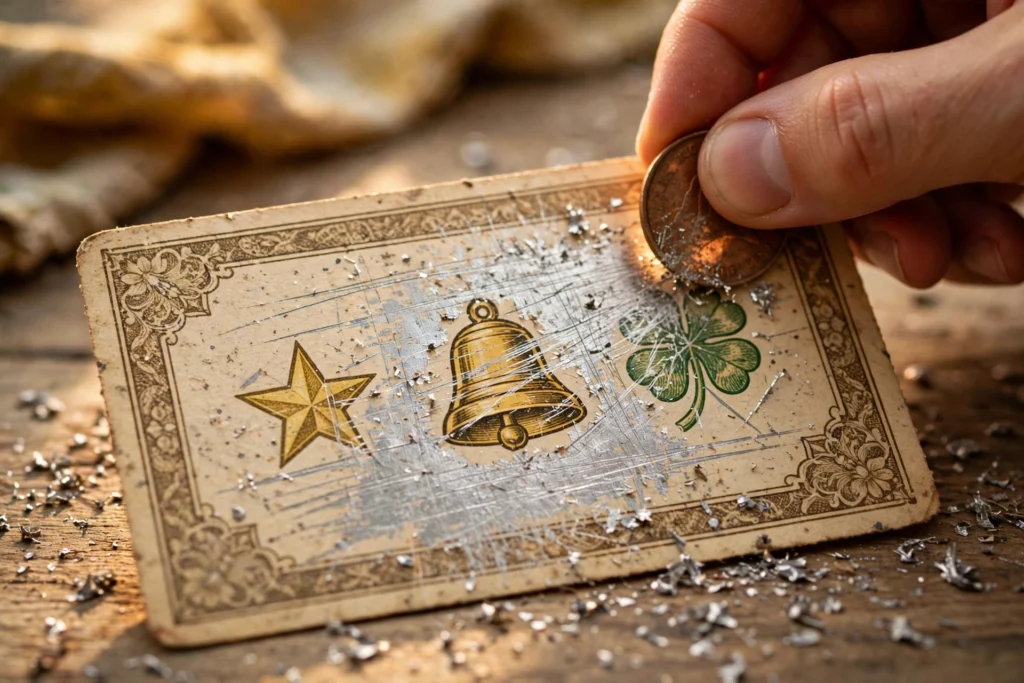
The history of scratch cards is surprisingly short. Before 1974, they did not exist at all — every lottery meant waiting days for a draw. Then two computer scientists with an idea borrowed from grocery-store bingo cards created the first instant-win game, and within a week it had sold $2.7 million worth of tickets in a single state. Today, scratch cards are sold in almost every country with a lottery, generating tens of billions of dollars a year. This is the story of how a scratched-off coating changed the lottery forever. Lottery play is for adults only — you must be 18 or over to play in most places, and always play responsibly, within a budget you can afford to lose.
Table of Contents
- Before Scratch Cards: Waiting for the Draw
- The 1974 Invention: John Koza and Daniel Bower
- The Instant Game Takes Off in Massachusetts
- The 1980s Boom: Dispensers and Bigger Games
- Scratch Cards Go Global
- The Digital Era: Online Scratch Cards
- How Modern Scratch Cards Are Made and Secured
- Scratch Cards vs Draw Games
- Frequently Asked Questions
- Conclusion
Before Scratch Cards: Waiting for the Draw
To understand why scratch cards were revolutionary, you have to picture the lottery before them. Traditional lotteries worked on a simple rhythm: buy a ticket, wait for the weekly draw, check your numbers. The waiting was part of the experience, but it was also a limitation. Players who wanted an instant result had no option at all.
There were early precursors. In the late 1800s and early 1900s, “pull tabs” — small paper tabs attached to products like beer cans and gum — offered instant prizes when pulled open. In the 1950s and 1960s, American grocery stores handed out promotional bingo-style cards: match the symbols printed in the newspaper and win food or money. Some of these cards had a waxy coating that could be rubbed off to reveal a prize. The idea of hiding a result under a scratchable surface was already in the air. What nobody had done was turn it into a proper lottery game.
The 1974 Invention: John Koza and Daniel Bower
The history of scratch cards begins with John Koza, an American computer scientist with a Ph.D. from the University of Michigan. In the early 1970s, Koza worked for J&H International, a company that printed bingo cards for US grocery stores. He developed the algorithms that kept those promotional card games fair — making sure the right number of winners was printed and that nobody could predict which cards would win.
In December 1972, two things happened: Koza earned his Ph.D., and he was fired from his part-time job at J&H. Suddenly free, he started thinking about whether the same concept could be adapted to a lottery game — one that eliminated the waiting period entirely. Scratch a ticket, and you would know instantly whether you had won.
Koza knew the maths, but he needed someone who could sell the idea. He partnered with Daniel Bower, a retail promotions specialist and former J&H colleague. Together they built a system for computer-generated, randomised scratch cards: a card with numbers or symbols hidden under a coating that could be scratched away to reveal the result. In 1973, the pair founded the Scientific Games Corporation to bring the idea to market.
The Instant Game Takes Off in Massachusetts
Scientific Games pitched the concept to the eight state lotteries operating at the time. Most said no. The breakthrough came in Massachusetts, where the head of the lottery commission, William Perrault — himself a University of Michigan graduate — agreed to give the idea a shot and ordered 25 million cards.
The game was called “The Instant Game,” and it launched in May 1974 with a top prize of $10,000, plus entry into monthly $100,000 drawings for some players. The result was extraordinary. Massachusetts players had been buying roughly $1 million worth of traditional six-digit lotto tickets a week. In the first seven days of marketing the instant-win cards, the state sold $2.7 million worth of them — nearly tripling the usual weekly lottery revenue. The instant-win revolution had begun.
The success was not just about novelty. The scratch card solved a real problem for lotteries: it gave casual players something to do between weekly draws, and it gave retailers a product that sold itself at the counter. Scientific Games’ revenue grew from $1.1 million in 1974 to $15 million by 1976, and in 1981 Koza sold the company to Bally Manufacturing.
The 1980s Boom: Dispensers and Bigger Games
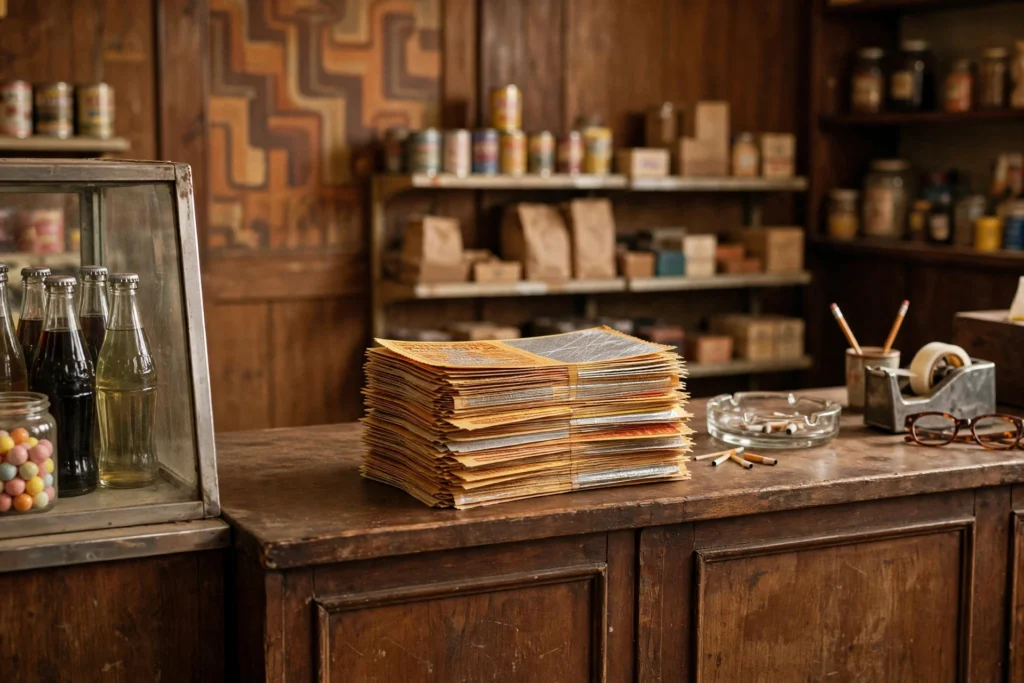
The 1980s turned scratch cards from a novelty into a mainstay. In 1985, an inventor named Cal Tigner changed the business again with the Take-a-Ticket dispenser — a simple display unit that let shops show scratch tickets neatly at the counter instead of keeping them in a drawer. The first dispenser went into a shop in Oregon in the fall of 1985, and the first large order of 1,000 units followed on Valentine’s Day 1986. Suddenly every convenience store could sell scratch cards without taking up counter space.
The games themselves grew too. In 1987, Missouri launched the first $2 instant-win game, and the patent for the scratch-off lottery card was bought by Astro-Med Inc. that same year. By the end of the decade, scratch cards were widely available across North America and Europe, with themed designs, bigger prizes, and new play styles — match three symbols, reveal numbers, bingo-style grids, and crossword formats. The 1980s also saw a specialist invent a new water-based coating that was more resistant to abrasion, making tickets harder to tamper with.
Scratch Cards Go Global
Scratch cards reached the UK in 1995, when the National Lottery began offering printed scratch card games to its players — eight years after some accounts claim, and more than two decades after the Massachusetts launch. From there, they spread to lotteries across Europe, Asia, Africa, and Latin America. By 2000, scratch cards were being purchased worldwide, with more than 30 billion instant-win tickets sold and over $50 billion in annual sales.
Each country adapted the format to its own market: different price points, different themes, and different prize structures. But the core idea never changed — a hidden result, a coin or a fingernail, and an answer in seconds. For the full sweep of lottery history, see our guide to the history of lotteries from ancient China to modern draws.
The Digital Era: Online Scratch Cards
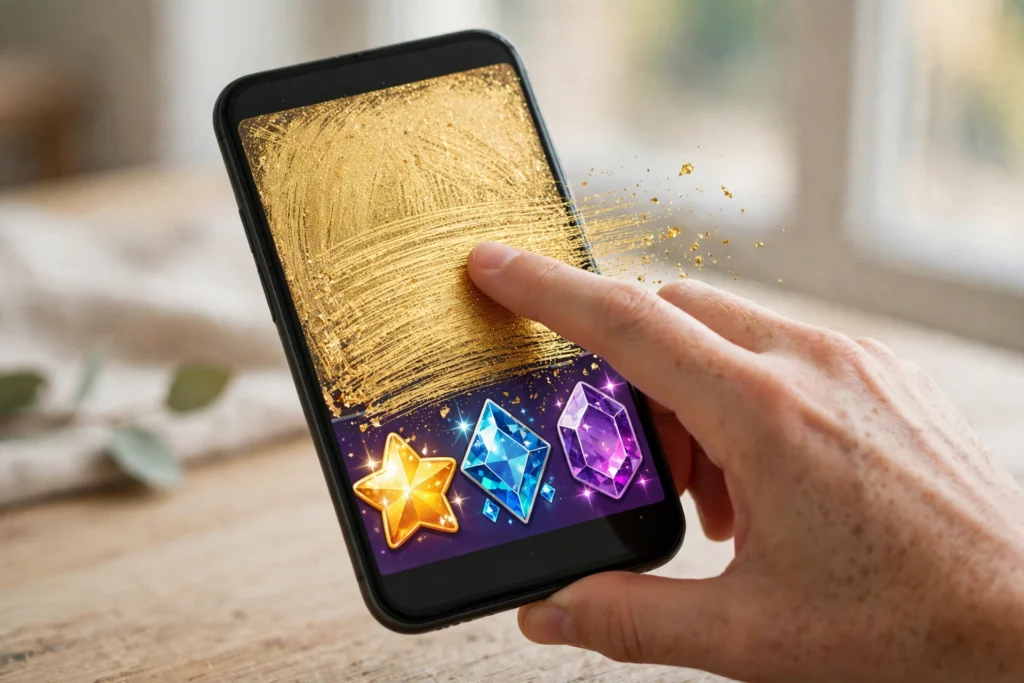
The arrival of the internet and mobile phones gave scratch cards their second act. Digital scratch cards offer the same instant-win experience online: tap or swipe to reveal symbols, with the result determined the moment you play. They come with advantages the paper version cannot match — animated themes, licensed brands from films and television, and instant prize crediting. They also come with the same risks, and the same need for limits: the instant result that makes scratch cards fun is also what makes them easy to play repeatedly without pausing.
Regulated online scratch games use certified random number generators to determine results, and licensed operators are required to publish the odds and return-to-player figures for each game. Unlicensed websites offering “scratch card” games are a common source of scams — always check that an operator is licensed by your country’s gambling regulator before playing.
How Modern Scratch Cards Are Made and Secured
A modern scratch card is a small piece of security engineering. The winning and losing combinations are generated by computer before printing, so the number of winners at each prize level is fixed in advance. The latex coating that hides the play area is designed to be opaque and tamper-evident: it cannot be peeled off and reapplied, and attempts to see through it with light or chemicals will damage the ticket. Each card carries a unique serial number and barcode, so a winning ticket can be verified at any retailer terminal — and a fake one is caught immediately.
Behind the scenes, independent testing labs certify the printing and randomisation systems, and lotteries audit the distribution of winners to make sure the published odds match reality. Our guide to lottery ticket security features explains the full range of anti-fraud measures used on paper tickets.
Scratch Cards vs Draw Games
Scratch cards and draw games serve different moods. Draw games like Powerball or the UK Lotto offer huge jackpots and a shared weekly ritual, but the odds of the top prize are extremely long — around 1 in 292 million for Powerball. Scratch cards offer much smaller top prizes but far better odds of winning something, with some games offering overall odds of around 1 in 3 or 1 in 4. The trade-off is the experience: a draw game gives you days of anticipation, while a scratch card gives you an answer in seconds. Neither is “better” — they are different products for different players. Our comparison of scratch cards vs draw lotteries breaks down the odds, costs, and prize structures side by side.
Frequently Asked Questions
Who invented the scratch card?
The modern scratch card was developed by American computer scientist John Koza and retail promotions specialist Daniel Bower. They founded Scientific Games Corporation in 1973, and the first game, “The Instant Game,” launched with the Massachusetts Lottery in 1974.
When were scratch cards first sold?
The first mass-produced scratch cards went on sale in Massachusetts in May 1974. They sold $2.7 million worth in their first week — nearly three times the state’s usual weekly lottery revenue.
How much did the first scratch cards cost and what could you win?
The original 1974 “Instant Game” had a top prize of $10,000, with some players also winning entry into monthly $100,000 drawings. The first $2 scratch game came later, launched by Missouri in 1987.
When did scratch cards come to the UK?
Scratch cards were introduced to the UK in 1995, when the National Lottery began offering printed scratch card games — more than twenty years after their invention in the United States.
Are scratch card results predetermined?
Yes. The winning and losing combinations are generated by computer before the tickets are printed, so the number of prizes at each level is fixed in advance. The coating simply hides a result that already exists. Digital scratch games use certified random number generators instead.
How big is the scratch card market today?
By 2000, more than 30 billion instant-win tickets were being sold worldwide each year, generating over $50 billion in annual sales — and the market has kept growing since, with digital versions adding a large online segment.
Conclusion
The history of scratch cards is a story of a simple idea executed brilliantly: take the lottery, remove the waiting, and put the answer under a coin’s scratch. From John Koza’s algorithms and a 25-million-card gamble in Massachusetts to dispensers in every corner shop and digital games on every phone, scratch cards went from nonexistent to universal in a single generation. They remain one of the most popular lottery products in the world — not because they offer the biggest prizes, but because they offer the fastest answer. If you play them, treat them like any other lottery product: set a budget, enjoy the instant fun, and stop when the fun stops. Lottery play is for adults only — you must be 18 or over to play, so please play responsibly and never spend more than you can afford to lose.